
 Einloggen


A carbide drill bit is a drill whose tip is made of tungsten carbide particles bonded with a metallic binder such as cobalt or nickel.
If carbide is so much harder than steel, why does it sometimes fail faster than a cheap high-speed steel bit? Because hardness is only half the story. A carbide edge resists wear brilliantly, but it tolerates bending, wobble, and impact poorly. Understanding what is a carbide drill bit means understanding that trade-off, not just memorizing a hardness number.
Table of Contents
- What a Carbide Drill Bit Is at a Glance
- How Carbide Is Built Into a Drill Bit
- How Carbide Compares With HSS and Other Bits
- Where Carbide Drill Bits Work Best
- Limits, Misconceptions and When to Replace a Bit
- Choosing the Right Carbide Bit for Your Job
What a Carbide Drill Bit Is at a Glance
Pick up a carbide-tipped bit next to a same-size steel bit and two differences show up fast: the carbide version feels heavier, and the cutting end is a separate piece of grey material brazed onto a steel shank. On a solid carbide bit the entire tool is that grey material. Either way, the working part is a composite built from powder, and it behaves much more like a ceramic than like the steel around it.
The structure works like concrete. The carbide grains are the hard aggregate, and the binder is the cement locking them in place. The aggregate resists scratching and wear, while the binder keeps the whole edge from behaving like glass. That is why a carbide bit is better understood as a small system of material, grade, form and setup rather than a hardness number on a label.
That structure explains the on-site advantage. When you drill hardened steel, cast iron, or masonry, a steel edge rounds over quickly because hot, abrasive particles grind it away. A carbide edge keeps its shape longer, so the hole stays closer to size and you don't need to force the bit.
Core properties of tungsten carbide used in drill bits
| Property | Typical behavior | What it means when drilling |
|---|---|---|
| Melting point | Far above the heat a cutting edge generates | The edge stays stable under friction heat |
| Density | Noticeably higher than steel | The bit feels heavy for its size |
| Elastic modulus | Very stiff, well beyond steel | The edge resists bending under load |
| Hardness | Far above hardened tool steel | The edge resists abrasive wear and rounding |
| Hardness hot vs cold | Holds most of its hardness as the cutting zone heats up | The bit keeps cutting when the tip runs hot |
The trade-off sits in the shadow of that stiffness. The same hardness and heat resistance that keep an edge sharp also mean the edge wants a steady, straight load. On a rigid drill press, carbide can run for a long time with little visible wear. On a flexing hand drill, every wobble lands as a small impact the edge has to absorb, and that is where chips start. Hardness wins the abrasion fight, and your setup decides whether brittleness gets a vote.
How Carbide Is Built Into a Drill Bit
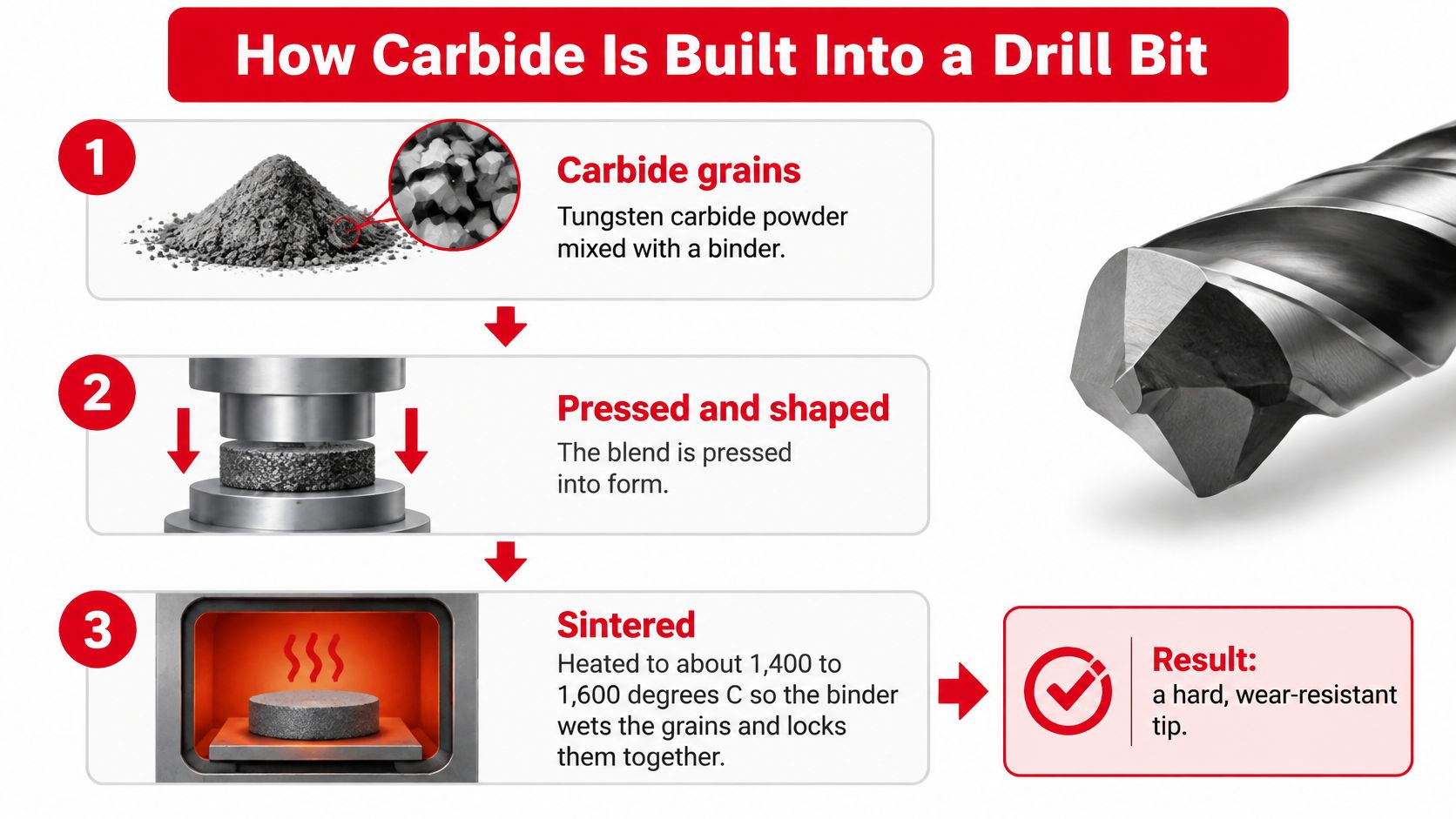
Start with the grains. Manufacturers mix tungsten carbide powder with powdered binder, press the blend into shape, and sinter it so the binder wets and bonds the grains. The result is a dense blank that can then be ground into a sharp point.
The visual below shows that build sequence in three stages.
The binder does the toughness work
Cobalt or nickel doesn't cut the workpiece. It holds the grains together and absorbs small shocks that would otherwise crack the edge. As the ScienceDirect tungsten carbide topic overview explains, carbide supplies extreme hardness and wear resistance while the binder improves toughness because pure tungsten carbide is too brittle for many operations. That balance is adjustable, and it's what makers mean by a grade.
- Finer grains and less binder: more hardness and abrasion resistance
- Coarser grains and more binder: more toughness against chipping
A low-binder grade on a wobbly hand drill is a mismatch. It may be the most wear-resistant option in the catalog and still fracture on the first hole because the load is impact, not abrasion.
Three forms you can identify by sight
Solid carbide drills are carbide along the full body. They're the stiffest and most wear resistant, and also the least forgiving if you flex them sideways. Carbide-tipped bits show a distinct carbide tip or insert on a steel body, which absorbs more shock. You'll see this form on masonry bits in a rotary hammer. Carbide hole cutters carry individual carbide teeth around a larger ring body, so only a thin ring of material is cut on big holes.
Point angle, flute shape, and coating sit on top of that material choice. The flutes clear chips, the point decides how the bit enters, and a coating can reduce friction. None of those fix a wrong grade. For a deeper look at how grades and coatings interact, the EZARC carbide technology overview walks through the construction choices in more detail.
How Carbide Compares With HSS and Other Bits
Put a solid carbide bit in a wobbly hand drill and a cheap HSS bit will outlive it. Read this comparison by failure mode, not by price. Ask what kills the edge first in your material: heat and abrasion, or flex and impact. Each bit type below trades hardness against toughness in a different way, and that trade-off decides which one survives your setup.
Carbide drill bits compared with other common bit types
| Bit type | Wear resistance | Toughness | Reference cutting speed | Best fit |
|---|---|---|---|---|
| Solid carbide drill | Highest; holds edge at high heat | Low; chips if flexed or misaligned | About 20 to 25 m/min | Hardened steel, cast iron, stainless steel on a rigid setup |
| Carbide-tipped drill | High at the tip; steel body absorbs shock | Moderate to high | Set by masonry rotation and hammer action, not metal cutting speed | Masonry, concrete, brick and other hard building materials |
| High-speed steel (HSS) | Moderate; edge softens as heat builds | High; forgiving of setup errors | About 5 to 7 m/min | Wood, plastics, mild steel and general-purpose drilling |
| Cobalt HSS | Better heat resistance than plain HSS | High | Set by workpiece hardness and coolant, between HSS practice and carbide practice | Stainless steel and tougher metals where carbide is not required |
Reference cutting speeds in the table come from the Wieland tungsten materials comparison.
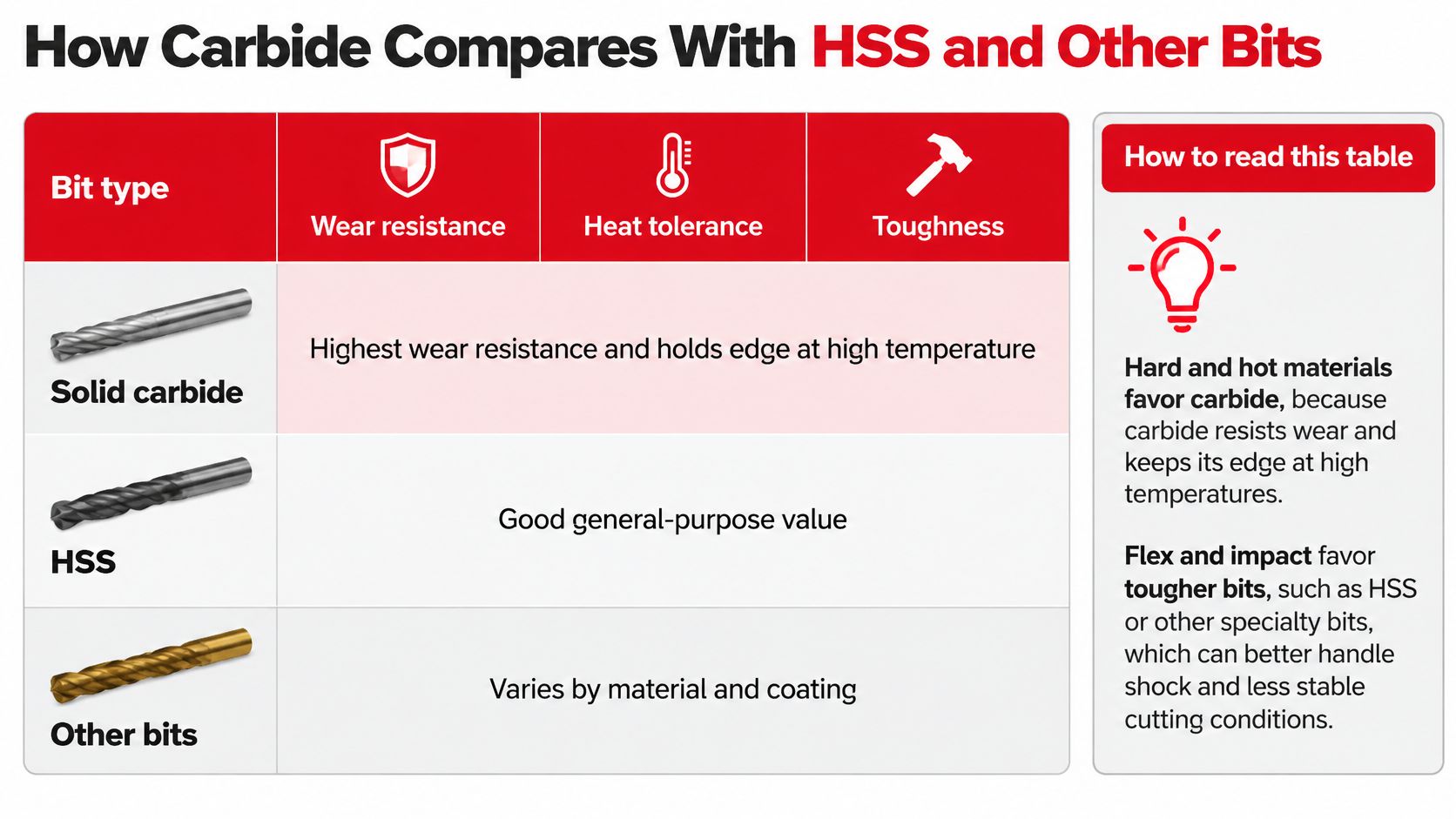
Solid carbide works like a glass pane: nothing scratches it, but a sideways knock cracks it. HSS works like spring steel: it bends, complains, and keeps cutting, which is why it survives a loose chuck or a hand drill that wanders. Keep in mind that toughness here means shock absorbed before chipping, not overall durability. Cobalt HSS narrows the heat gap without giving up much toughness, so it is a sensible middle step for stainless work. For soft timber, none of this applies, and a shop stocking auger bits for wood drilling from Yasu Trading Co. LLC covers a job carbide isn't meant for.
Why the speed gap exists
Under the stated conditions, carbide runs at roughly three to four times the cutting speed of HSS, and the mechanism behind that gap is hot hardness. At high cutting temperature the carbide edge keeps its geometry, so abrasive wear and edge softening progress slowly. An HSS edge behaves differently. Once it rounds over, thrust rises, heat rises, and the hole goes oversize. On stainless, that rubbing can also work-harden the surface and make the next pass harder on the bit.
Treat those figures as a reference, not a prescription. Reduce speed and feed for poor rigidity, interrupted entry, thin sections, deep holes, weak coolant, or poor chip evacuation. Feed too hard and you overload a brittle edge. Feed too lightly and the edge rubs instead of cutting, which builds the same heat you were trying to avoid. Watch chip form, spindle load, hole size, and edge condition, then adjust. The guide to the difference between drill bit types helps when you're sorting a mixed bit drawer before a job.
Practical rule: hard and hot favors carbide; flex and impact favors a tougher bit.
Where Carbide Drill Bits Work Best
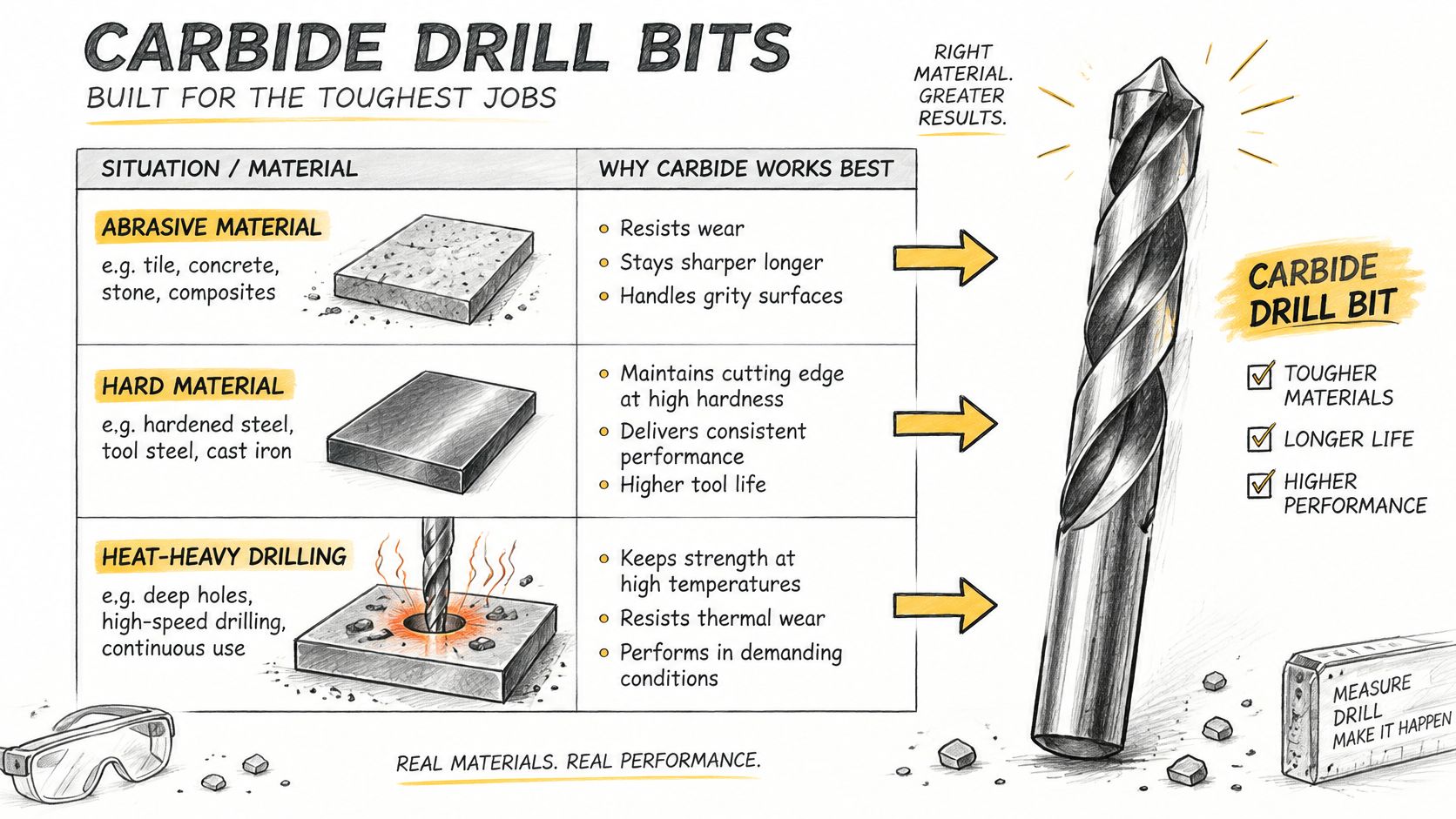
Carbide earns its cost when the workpiece is abrasive, hard, or heat-generating, because those are the conditions that destroy steel edges fastest. If none of the three apply, you're usually paying for wear resistance you'll never use.
This infographic maps those three conditions to typical jobs.
Common materials and the carbide bit form that suits them
| Material | Why carbide helps | Typical bit form |
|---|---|---|
| Hardened steel and tool steel | Edge holds against abrasive wear | Solid carbide drill |
| Stainless steel and high-alloy steel | Resists heat and work-hardening effects | Solid carbide drill or carbide hole cutter |
| Cast iron | Abrasive surface wears HSS quickly | Solid carbide drill |
| Concrete, brick and masonry | Hard aggregate would abrade steel | Carbide-tipped masonry bit |
| Fiber cement and composites | Abrasive fibers dull steel edges | Solid carbide drill |
| Wood and plastics | Carbide is rarely needed | High-speed steel bit |
Say you're drilling a row of holes in a cast iron plate. The surface skin is abrasive, so an HSS edge dulls partway through and starts squealing. Solid carbide holds its geometry, so hole ten looks like hole one. Contrast that with drilling timber studs, where the material is soft and the bit needs to clear long chips, not resist abrasion. HSS is cheaper and survives the odd sideways knock.
For larger holes in hard metal, a ring cutter changes the maths because you remove a narrow kerf instead of turning the whole diameter into chips. The introduction to using carbide hole saws covers that form in practice.
The clip below shows the cutting action on hard material, worth watching for chip flow and steady feed.
Material alone doesn't decide it. Hole size, machine rigidity, and cost per hole all count, and a rigid drill press can use a bit that a worn hand drill would snap.
Limits, Misconceptions and When to Replace a Bit
A carbide edge rarely fails the way a steel edge does. Steel rounds over gradually and gives a long warning. Carbide holds a keen corner through hundreds of holes, then a single catch on an interrupted cut pops a flake off the lip, and hole quality drops at once. That sudden failure shapes both the myths below and the warning signs you watch for.
Four misconceptions worth dropping
- The hardest grade is the safest buy: hardness and toughness pull against each other, so a wear-resistant edge can still chip under runout, vibration, interrupted cutting, or poor workholding.
- Carbide never wears out: it wears slowly, then often fails suddenly by chipping rather than gradually by rounding.
- Carbide runs at any speed: speed, feed, coolant, and point geometry must match the grade and the workpiece.
- The carbide label settles the choice: substrate grade, coating, and geometry matter as much as the word on the packet.
That last point is where most buying mistakes happen. The IM-Mining report on cemented carbide innovation at Sandvik underlines that performance depends on the grade and the balance among hardness, wear resistance, and fracture toughness. Two bits can both say carbide and behave very differently in stainless, because one was graded for abrasion and the other for interrupted cuts. Treat solid carbide drills, carbide-tipped masonry drills, and carbide hole cutters as separate categories rather than interchangeable versions of one product.
Signals that a bit is done
Replace or retire the bit when you notice these changes compared with how it drilled when sharp:
- Longer drilling time: the same hole takes noticeably longer at the same settings.
- Overheating: the bit or hole darkens, discolors, or smokes.
- Wandering: the point skates off center on entry instead of biting.
- Visible chips: small flakes missing from the cutting lip or corners.
- Abnormal noise: squeal, chatter, or a harsher tone than usual.
- More hand pressure: you're leaning on the drill to keep it cutting.
- Rising handle vibration: the tool buzzes more through your hands.
One signal alone can be a setup problem, so check clamping and speed first. A wandering point on a fresh bit usually means the workpiece shifted, and chatter on a rigid press can mean the feed dropped low enough that the edge rubs instead of cuts. Two or three signals together mean the edge has gone. Forcing it further doesn't save money. It generates heat, risks chipping the edge into the workpiece, and can leave a hardened, oversize hole that takes longer to fix than the original job.
Wear costs more than time. The OHS Online report on NIOSH-funded drilling studies found that when drilling concrete, sharp carbide-tipped bits produced less dust, noise, and hand vibration than dull bits, while worn bits increased drilling time by up to 60% and generated about twice as much silica dust. A slow bit keeps you in the dust cloud longer and makes more of it.
Fresh edges are an exposure control in their own right, and the usual controls still apply. Use dust extraction, wet methods where appropriate, hearing protection, eye protection, ventilation, and respiratory protection when exposure limits may be exceeded. Take extra care when grinding or heating cemented carbide, since that can release hazardous dust or fumes from the tool material itself, separate from whatever the workpiece produces.
If a bit has become slow, loud, and dusty, it isn't earning its keep. Change it.
Choosing the Right Carbide Bit for Your Job
A carbide bit that excels in one shop can chatter itself to pieces in another, because the bit is a system: material, grade, form, and the machine behind it. Work through four checks before you buy.
- Name the material and its hardness: hardened steel, cast iron, masonry, and composites justify carbide; soft wood and plastic usually don't.
- Decide the failure mode: abrasive wear points to solid carbide, impact and chipping point to a tougher grade or a carbide-tipped form.
- Match the form: solid carbide for hard metal on a rigid setup, carbide-tipped for masonry, carbide hole cutters for larger diameters.
- Confirm the machine: a rigid drill press can run the higher reference speeds, a loose hand drill calls for a tougher grade and gentler settings.
Step two is where new buyers slip. Hardness and toughness pull in opposite directions: a harder grade shrugs off abrasion but chips sooner under impact, so a bit that lasts for years on a drill press can fail in minutes in a handheld tool. For a plain walkthrough of matching bits to materials, a contractor's guide to cleaner drilling covers the selection basics.
The form step has concrete examples. The EZARC Carbide Hole Saw Drill Bit/Center Pilot Drill Bit pairs the cutter with a pilot bit to keep larger holes tracking on center, with a regular price starting at $8.95. For shallower cuts in hard metal, carbide hole saws cover diameters from 9/16 inch to 2-15/16 inch, starting from $19.95.
Match the bit to the material and the setup, and carbide will repay you in clean, consistent holes. Browse the carbide hole cutters, pilot bits, and drilling accessories at EZARC Tools and choose the form that fits your next job.