
 Oscillating Multi-Tool Blades
 Reciprocating Saw Blades
 Cutting & Grinding
 Hole Saw
 Drilling
 Sanding & Polishing
 Socket & Driver Set
 Hand Tools
 Metal Worker & Fabrication
 Woodworking & Carpentry
 Electrical & Plumbing
 Automotive
 Concrete & Masonry
 Demolition
 NEW ARRIVALS
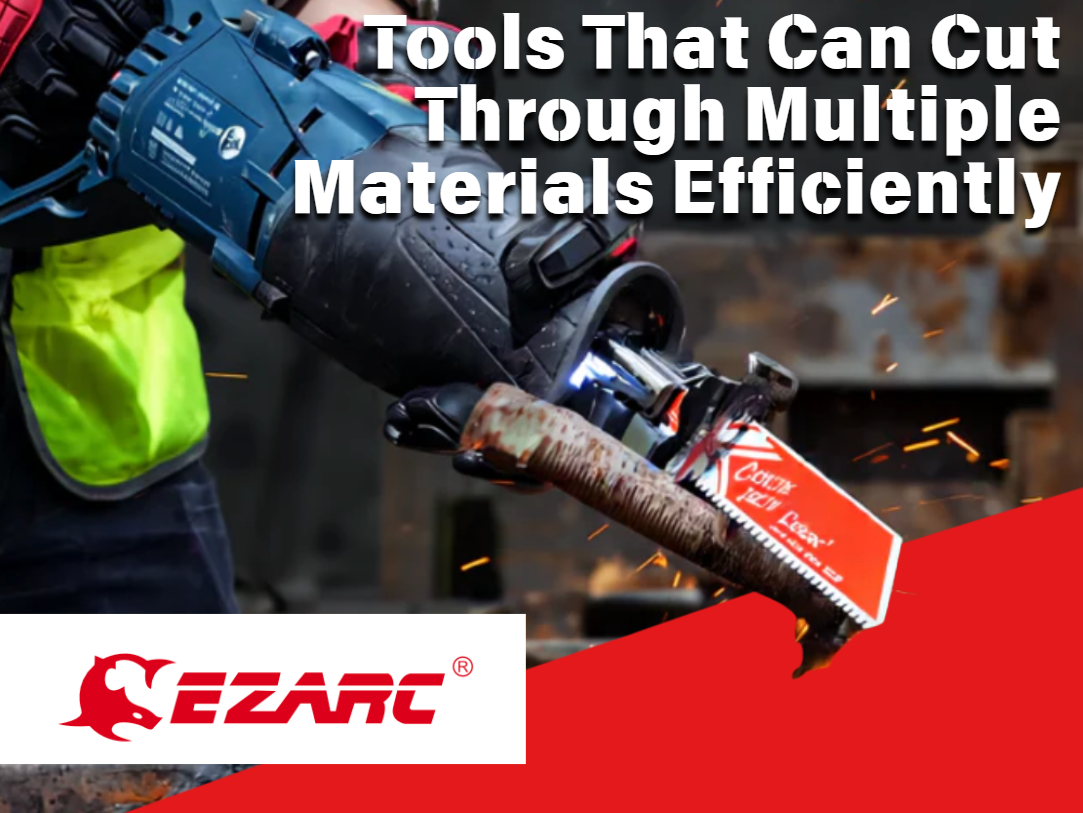
Tools That Can Cut Through Multiple Materials Efficiently
Introduction
If you're trying to keep a job moving, Reciprocating Saw Blades are often your best bet. The right blade can make the difference between using "one tool for many materials" and constantly swapping blades, which can kill momentum. Whether you're a contractor removing nail-embedded framing, a DIYer trimming storm-damaged limbs, or a maintenance tech cutting mixed materials in tight spaces, the goal is always the same: cut faster, bind less, and reduce accessory changes.
In 2026, the "fewer tools, higher versatility" approach continued trending, as teams prioritized uptime and controlled consumable use while hitting deadlines. The focus shifted to durability and consistency, as crews opted for quality over cheap multi-packs that wear out quickly. (AMT cutting tool market data, 2026.)
Below is an EZARC-only list of essential multi-material jobsite tools, starting with Reciprocating Saw Blades, followed by other tools like Oscillating Multi-Tool Blades, Cutting and Grinding Discs, Hole Saw Kits, Drill Bits, Sanding Abrasives, Socket and Driver Sets, and Hand Tools—all designed to help you cut, drill, remove, and finish efficiently. No competitor callouts, just tools that deliver results.
Picks for Multi-Material Cutting
1) Tree Trimming/Wood Cutting
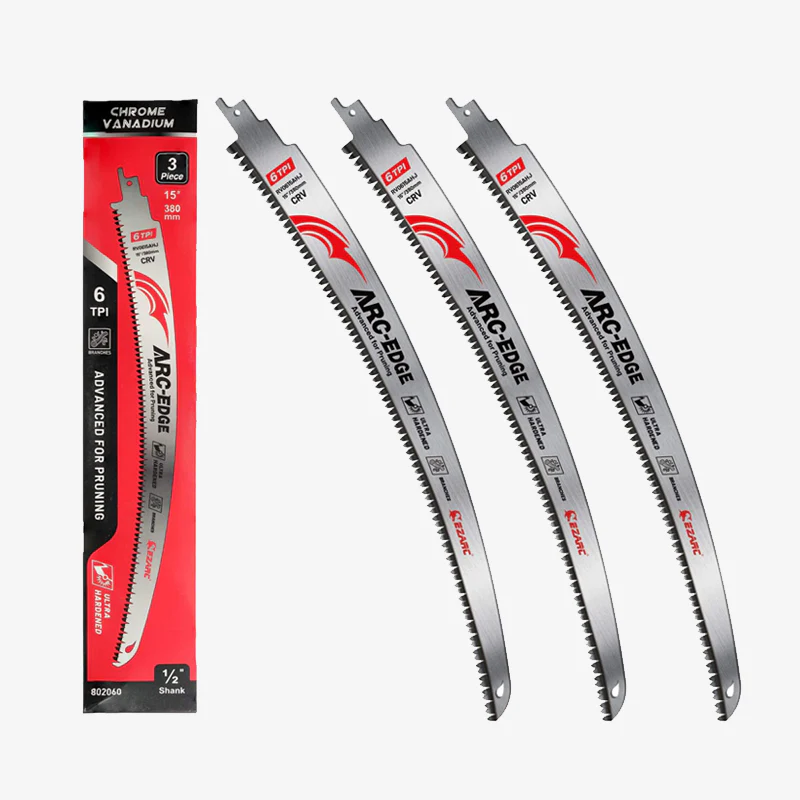
Japanese Teeth 6 TPI Reciprocating Saw Blade
If your “multi-material” day includes green wood first (and demolition later), this pruning-focused blade is the fastest way to keep your reciprocating saw useful outside the framing bay. The curved arc-edge profile helps clear a wide kerf in wet wood, which matters when chips pack up and a straight blade starts to bind mid-cut.
- Best for: pruning thick limbs, storm cleanup, breaking down green wood, rough firewood prep
- Standout feature: 15-inch arc edge that improves leverage and helps kerf clearing in wet wood
- Tooth design: Japanese-style, aggressive fleam-ground teeth designed for fast, coarse cutting
- TPI: 6 TPI for high chip evacuation in thick, fibrous material
- Material: Cr-V (chrome vanadium) steel for durability and rust resistance in outdoor work
- Practical upside: the extra length helps reach into branch junctions without repositioning as often
Why it wins: For green wood, speed is mostly about chip removal and control. The arc edge and deep gullets keep the cut moving so you’re not “feathering” the trigger to avoid jamming. It’s a strong fit when you want chainsaw-like productivity but need a safer, lighter, battery-friendly setup for quick trims.
2) Nail-Embedded Wood/Pallet Dismantling – Bi-Metal, 9 in, 10/14 TPI Reciprocating Saw Blade
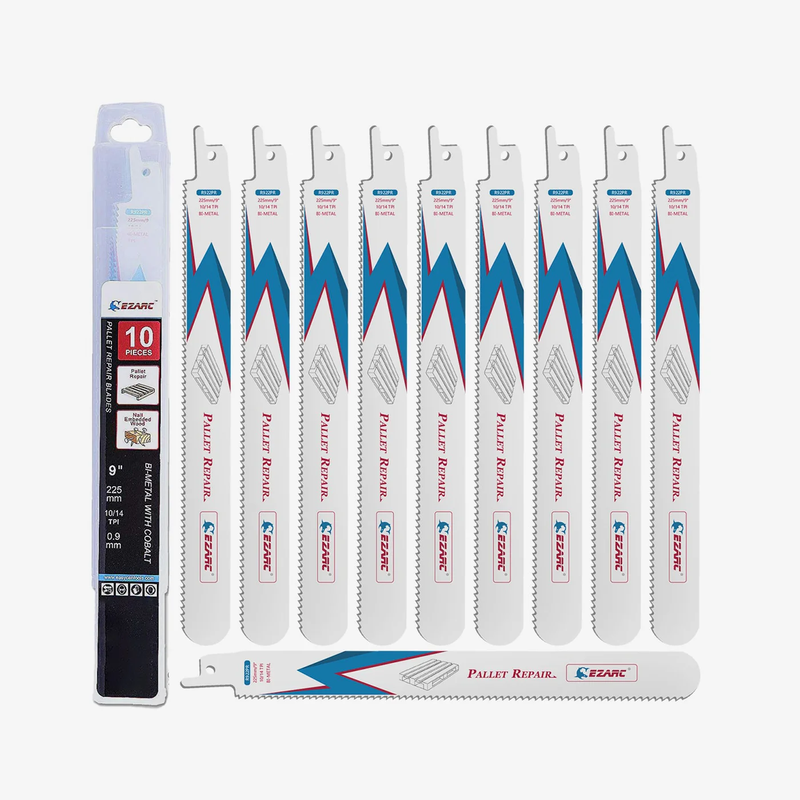
Pallet tear-down and nail-embedded lumber are where “one blade for everything” usually fails—because nails, grit, and fasteners punish tooth edges. This set uses a dual-TPI approach so you can choose a more aggressive option for thick slats and a finer option when you want control and cleaner cuts.
- Best for: pallets, reclaimed lumber, nail hits, staples, mixed slats, thin plywood and thicker boards
- Blade construction: bi-metal with 8% cobalt (HSS teeth bonded to a flexible steel body)
- TPI: 10 TPI and 14 TPI options for balancing speed vs cut control on varying board thickness
- Length: 9 in (225 mm) for reach through typical pallet assemblies
- Blade thickness: 0.9 mm for maneuverability while still tracking straight in wood
- Design detail: vario tooth concept + chip clearance to reduce heat and binding in dirty wood
Why it wins: Pallet work is less about “maximum speed” and more about staying productive after repeated nail strikes. Bi-metal is the practical middle ground: flexible enough to survive shock loads and hard enough to keep cutting when the wood is abrasive or contaminated.
3) Hard Wood/Metal Demolition
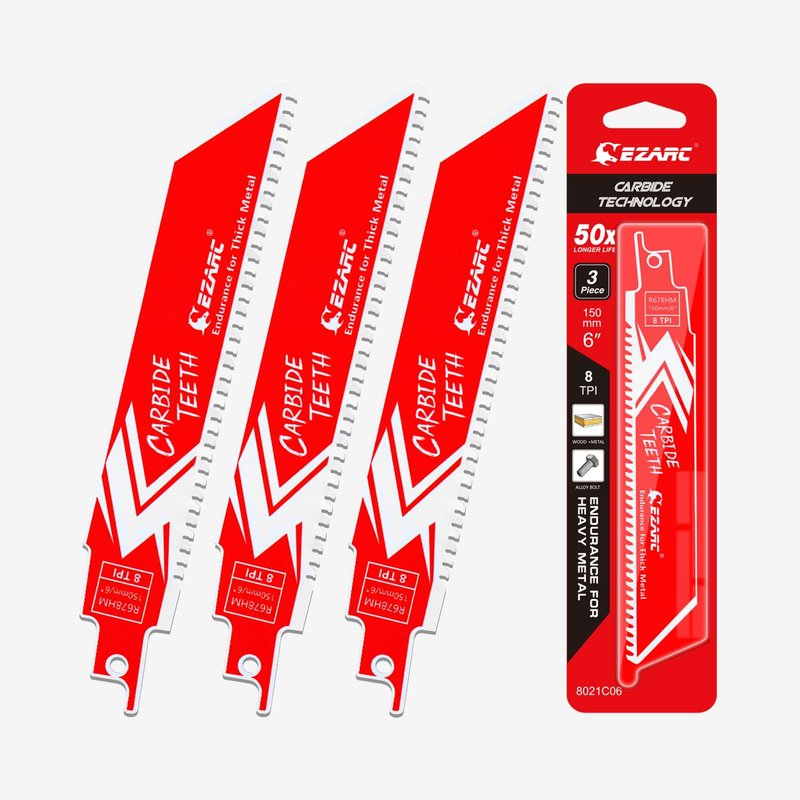
Carbide, 6/9 in, 6 TPI Reciprocating Saw Blade
When bi-metal starts dying early—especially in hard wood with surprise metal—carbide is the move. This blade targets demolition reality: impacts, mixed materials, and cuts that are rarely “clean and straight.” The coarse pitch helps keep cutting debris moving, which lowers drag and reduces heat buildup.
- Best for: renovation demo, hard wood, nail-embedded lumber, rusted fasteners, light metal hits
- Tooth type: carbide teeth (precision-welded; built for wear and impact resistance)
- TPI: 6 TPI for aggressive bite and better gullet space in thicker material
- Sizes: 6 in (150 mm) or 9 in (225 mm) for tight access vs reach
- Universal fit: 1/2-inch shank compatible with major reciprocating saw platforms
- Jobsite benefit: fewer blade changes when your cut line includes unknown fasteners
Why it wins: Multi-material demolition is where carbide earns its reputation—because it keeps working when you hit hardened surprises. If your workflow is “open wall, cut pipe strap, cut stud, hit nails,” carbide is often the most efficient path to fewer stoppages.
4) Tile and Grout Work
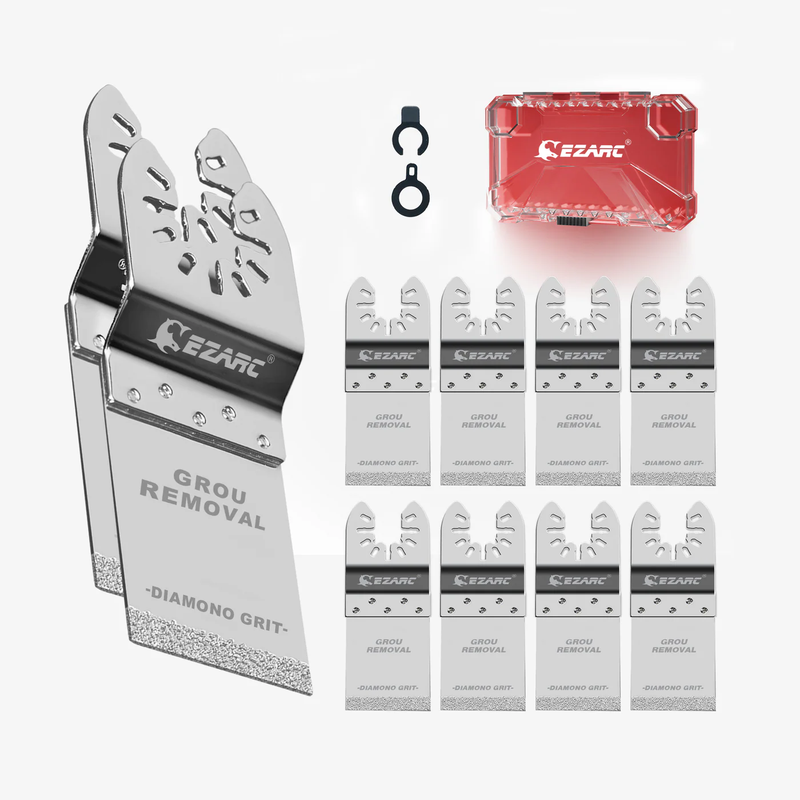
Diamond Oscillating Blade for Grout Removal (EID36)
When the reciprocating saw is overkill—or simply can’t fit—Oscillating Multi-Tool Blades fill the gap. For multi-material renovation, grout and mortar removal is a common bottleneck, and standard teeth-based blades can burn up quickly in abrasive mineral material.
- Best for: grout removal, mortar cleanup, porous concrete touch-ups, tight-corner tile repair
- Edge type: diamond grit for abrasive cutting rather than tooth-based shearing
- Kerf: about 1/16 in (1.6 mm) for controlled material removal
- Fitment: designed as a universal-fit oscillating blade; adapters included for broad compatibility
- Control advantage: oscillating motion limits kickback and helps you stay inside a joint line
- Productivity tip: short passes + frequent dust clearing typically outwork forcing the cut
Why it wins: Multi-material efficiency isn’t only about “cutting studs.” It’s also about clean removals that prevent rework. Diamond grit maintains consistent performance in grout lines, so your oscillating tool stays a reliable second tool instead of a frustration point.
5) Hard-Metal Plunge Cuts
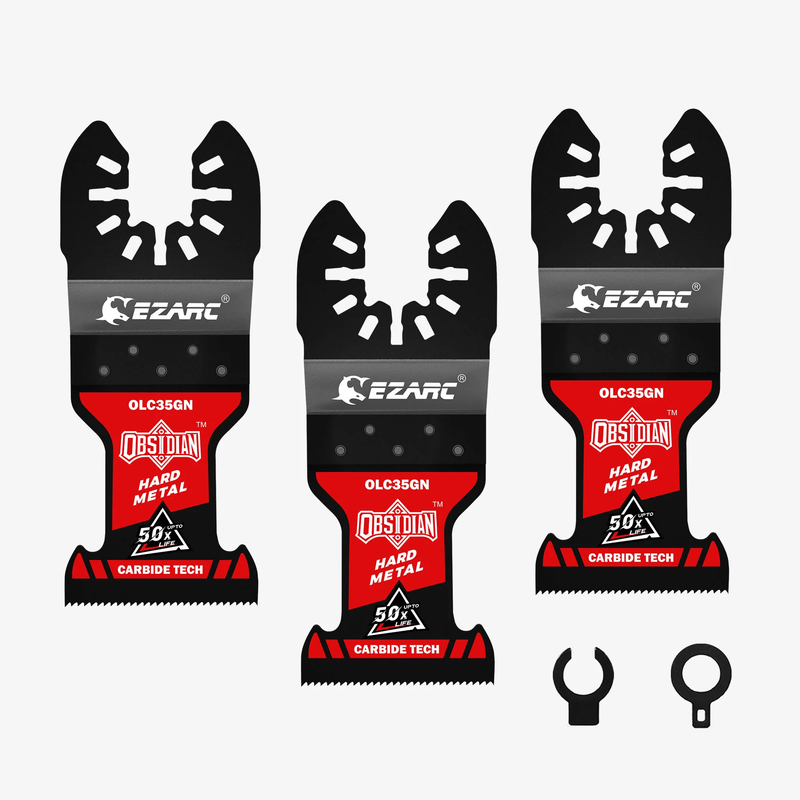
EZARC Obsidian Carbide Oscillating Saw Blades
If you’re doing remodel work, there’s always that moment when you need a controlled plunge cut into nails, screws, or thin metal in a spot the recip blade can’t reach without collateral damage. These carbide oscillating blades are aimed at that high-friction reality.
- Best for: masonry nails, screws/bolts, rebar encounters, copper pipe cuts in tight bays, wood+fasteners
- Coating: TiCN (titanium carbo-nitride) for wear resistance and heat tolerance
- Durability claim: designed for significantly longer life vs standard bi-metal multi-tool blades
- Design angle: thinner profile for faster cutting while keeping plunge control
- Use-case fit: notch-outs, undercutting trim, flush cuts near finished surfaces
- Workflow benefit: reduces “switch tools” moments during punch-list work
Why it wins: Oscillating blades are about control first and speed second. Carbide + a wear-resistant coating is what keeps the blade useful after repeated hard-metal contacts, which is exactly what happens in real-world plunge work.
Shop: https://www.ezarctools.com/products/ezarc-obsidian-carbide-oscillating-saw-blades
6) Fast Metal Stock Cutting
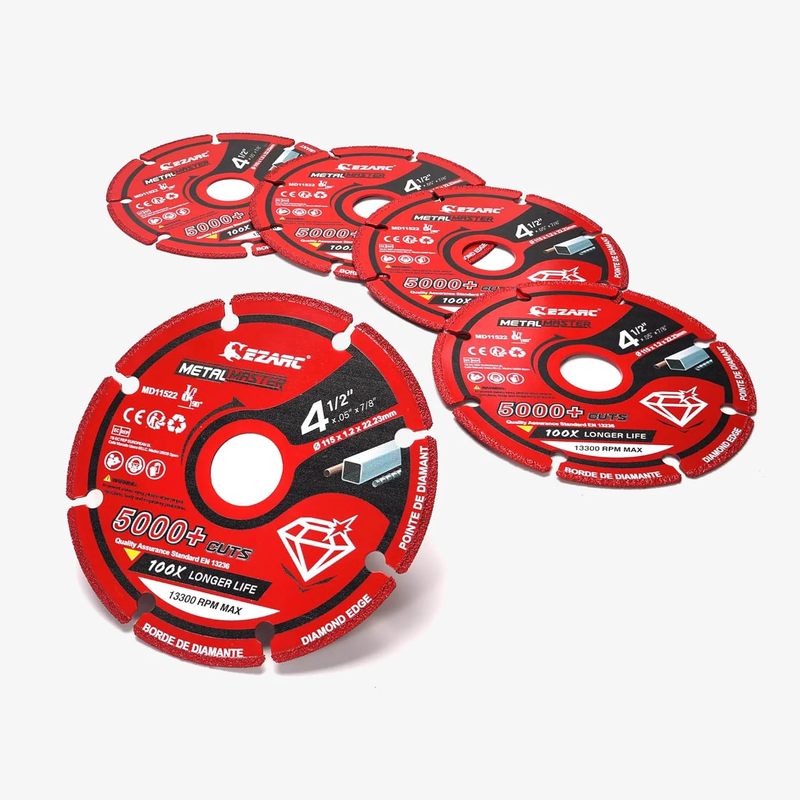
Diamond Metal Cutting Wheel
For straight-line metal stock cutting, Cutting and Grinding Discs can be the fastest option—especially when access is open and you want a stable, guided cut. A diamond cutting wheel also changes the wear pattern versus traditional abrasive cut-off wheels.
- Best for: rebar, steel, iron, stainless (inox), repeated cut-off tasks
- Approach: diamond cutting edge designed for long life and consistent diameter
- Safety advantage: designed to avoid the “disc shrinking” behavior typical of abrasive wheels
- Where it fits in a multi-material kit: metal stock prep before fitting or welding, quick removals
- Practical note: keep the grinder square; twisting the tool is what usually causes bad cuts and heat
- Jobsite efficiency: reduces time spent swapping between saws and grinders for metal-only steps
Why it wins: If your day includes a lot of metal-only cuts, a dedicated cutting wheel keeps your reciprocating saw from doing the wrong job. That division of labor is what makes a multi-material workflow genuinely efficient.
Shop: https://www.ezarctools.com/products/diamond-cutting-wheel
7) Clean, Controlled Step Holes
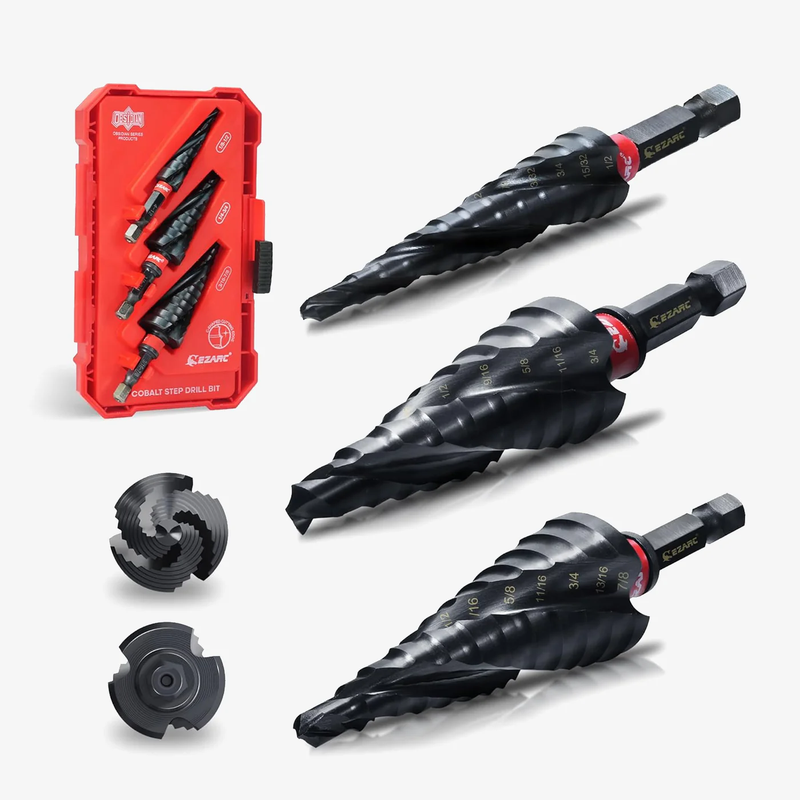
EZARC Step Drill Bit Set
For sheet metal, electrical work, and clean pass-throughs, Drill Bits and Sets can be more efficient than cutting wheels or recip blades—because they create a finished hole with minimal burrs and fewer secondary steps.
- Best for: metal, stainless steel, aluminum, plastic—especially thin sheet and panels
- Material: M35 cobalt steel for durability in harder metals
- Coating: AlTiN for heat resistance and reduced friction in sustained drilling
- Edge geometry: C-profile cutting edge intended for smoother starts and controlled enlargement
- Workflow advantage: size stepping reduces the need to swap multiple twist bits
- Practical use: pair with cutting fluid on stainless to reduce heat and work hardening
Why it wins: Step bits are one of the most “multi-material efficient” drilling solutions because they reduce tool changes while still giving you a clean, round hole. That matters when you’re installing hardware, running conduit, or doing panel work that can’t look hacked.
8) Versatile Site Drilling
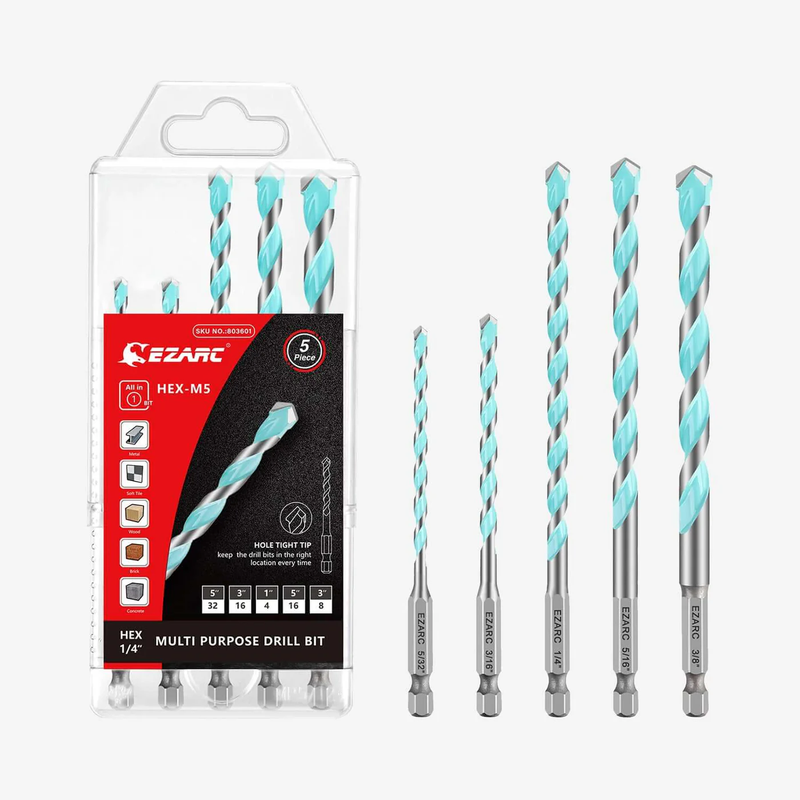
Hex Shank Tungsten Carbide Tipped Multi-Purpose Drill Bit Set
If you want “one bit set” that can bounce between materials during punch work, a carbide-tipped multi-purpose set is a practical approach. It won’t replace dedicated masonry or premium metal bits in every scenario, but it can drastically cut down the number of times you walk back to the truck.
- Best for: brick, block, tile, fiber cement, wood, plastic, and light-duty metal drilling
- Tip: tungsten carbide head for multi-surface wear resistance
- Set makeup: 5 pieces, 6-inch length in common sizes (5/32, 3/16, 1/4, 5/16, 3/8 in)
- Flute design: large U-flute intended to clear debris faster
- Shank: hex shank for strong grip in impact drivers and drill/drivers
- Efficiency angle: ideal as a “carry” set when you’re moving room-to-room
Why it wins: Multi-material efficiency is often about minimizing interruptions. This set is built around that reality: fewer bit swaps, fewer trips to grab a different drill index, and faster progress through mixed substrates.
Buying Guide: How to Choose Multi-Material Tools
A true multi-material setup is less about owning more tools and more about choosing the right “primary cutter” and the right “support tools” so you don’t force one accessory into every job. If you start with Reciprocating Saw Blades as your main workhorse, the next step is deciding when to switch blade types, and when to switch tool categories entirely.
Practical tips for faster, cleaner multi-material cuts
To cut faster, let the teeth do the work and avoid forcing the saw; excess pressure increases heat and makes blades wander. Keep the shoe planted firmly on the workpiece to reduce vibration—especially in Reciprocating Saw Blades cuts where bounce destroys control. Also, match speed to material: high speed can scorch wood and overheat metal, while moderate speed with steady pressure often improves both cut rate and blade life. https://www.directhardware.com.au/pages/how-to-choose-reciprocating-saw-blades
Common mistakes that slow you down
One of the biggest mistakes is using a fine-tooth blade in thick wood, which can clog gullets and stall the cut. Another is trying to “make do” with cheap blade packs during demolition—because frequent replacements cost more time than they save in money. Finally, many users try to solve everything with the reciprocating saw; in reality, oscillating blades, hole saws, and cutting discs often do specific steps faster and cleaner.

Where other categories fit
- Oscillating Multi-Tool Blades: best for flush cuts, plunge cuts, grout removal, and tight-access trimming where a recip can’t fit cleanly.
- Cutting and Grinding Discs: best for open-access metal stock cutting and fast cutoff tasks where a grinder provides better stability.
- Hole Saw Kits: best for repeatable round openings for hardware, pipe, and fixtures across wood, thin metal, and plastics.
- Drill Bits and Sets: best for clean holes, pilot drilling, and controlled enlargements—especially in sheet metal and panels.
- Sanding and Polishing Abrasives: best for finishing steps after cutting—deburring edges, smoothing surfaces, and prepping for paint.
- Socket and Driver Sets: best for teardown and assembly efficiency—removing fasteners quickly instead of cutting around them.
- Hand Tools: best for layout, scoring, prying, and controlled adjustments that reduce the number of powered cuts you need.
Comparison Table
| Blade/Tool Type | Length/Size | TPI / Kerf | Best Materials | Ideal Scenario | Key Design Feature | Pack Size | Trade-offs / Limitations |
| Japanese Teeth Reciprocating Saw Blade (Pruning) | 15 in | 6 TPI | Green wood, wet limbs, dense branches | Tree trimming + storm cleanup | Arc-edge profile + fleam-ground teeth | 3 pcs | Too aggressive for fine finish carpentry; not intended for frequent metal contact |
| Bi-Metal Reciprocating Saw Blade (Pallet/Nail Wood) | 9 in | 10/14 TPI | Nail-embedded wood, pallets | Pallet dismantling and reclaimed lumber | Dual-TPI options + bi-metal w/ cobalt | 10 pcs | Slower than coarse demolition blades in thick solid wood; fine TPI can heat if forced |
| Carbide Reciprocating Saw Blade (Demo) | 6/9 in | 6 TPI | Hard wood, mixed demo hits | Renovation demolition with unknown fasteners | Carbide teeth for wear/impact | 3 pcs | More aggressive cut can splinter exits; can be overkill for thin, clean finish cuts |
| Diamond Oscillating Blade (EID36) | Multi-tool | ~1.6 mm kerf | Grout, mortar, porous concrete | Tile repair and grout removal | Diamond grit edge | 3–10 pcs options | Not a fast wood-cutter; dust management is required for best performance |
| Diamond Cutting Wheel | 3–7 in options | N/A | Steel, rebar, inox | Straight metal cutoff work | Diamond edge for durability | Varies | Requires grinder control and PPE; not for tight flush cuts where oscillating excels |
FAQ
1) What TPI should I use for thick wood when speed matters?
Lower TPI is usually faster in thick wood because the gullets can move chips out of the cut instead of packing them in. In practice, 6 TPI is a common “aggressive” choice for thick branches, demolition lumber, and rough cuts where finish quality isn’t the priority. If you notice smoke, scorching, or frequent binding, slow down and consider a lower TPI or a blade with deeper gullets. Also, keep the shoe firmly planted to reduce vibration, because bounce makes any blade feel slower. https://www.empireabrasives.com/blog/what-does-tpi-mean-for-saw-blades
2) Why does my blade dull so fast when dismantling pallets?
Pallet wood is often dirty, abrasive, and full of hidden staples or hardened nails, which accelerates tooth wear dramatically. To reduce premature dulling, use a blade designed for nail-embedded wood (bi-metal is a solid baseline) and let the saw’s full stroke work rather than short-stroking in one spot. Keep your cut line away from nail clusters when possible, and avoid side-loading the blade because twisting can damage teeth even faster than nail hits. Finally, if you’re cutting a lot of pallets daily, consider upgrading the “problem cuts” to carbide.
3) What blade length is best for pruning branches without jamming?
Longer blades help because they clear chips better and let you finish thick cuts with fewer angle changes. A 15-inch pruning blade is especially helpful when you’re reaching into branch junctions or cutting overhead where repositioning is awkward. That said, match blade length to control: if you’re working in tight spaces, a shorter blade can track straighter and reduce accidental contact behind the cut. For best results, start the cut slowly to establish a groove, then increase speed once the teeth are fully engaged.
4) When should I choose carbide over bi-metal in demolition?
Choose carbide when bi-metal blades are failing early—especially if you’re hitting mixed materials like nails, screws, straps, or tougher alloys during the same cut. Carbide tends to hold up better under abrasive, high-wear conditions, which can reduce blade changes and downtime on renovation and teardown work. It’s also a smart choice when you can’t reliably “inspect the cut” ahead of time, like in wall openings or automotive dismantling. If your work is mostly wood with occasional small nails, bi-metal can still be the more forgiving daily option.
5) How do I reduce vibration and speed up reciprocating cuts?
First, keep the shoe pressed firmly against the workpiece—this stabilizes the saw and reduces blade chatter. Second, use steady pressure rather than forcing the cut; too much pressure increases heat and makes the blade wander, which feels like “slow cutting.” Third, choose the correct blade type for the material (for example, pruning geometry for green wood, bi-metal for nail wood, carbide for harder mixed demolition), because the wrong tooth pattern creates drag. If you’re still fighting vibration, check that your blade is straight and seated fully in the clamp. https://www.proconstructionguide.com/reduce-vibration-when-using-a-reciprocating-saw
Conclusion
To cut through multiple materials efficiently, build your workflow around the right blade for each task: pruning blades for green wood, bi-metal blades for nail-embedded lumber, and carbide-grit blades for tough metals. Complement these with oscillating multi-tool blades for tight spaces, cutting and grinding discs for fast metalwork, and hole saws and drill bits for clean, precise openings.

In short, the fastest multi-material setup isn’t one tool trying to do everything—it’s a curated kit of accessories that minimize changeovers, prevent jams, and keep downtime low. Explore EZARC’s range of blades, discs, and drilling accessories to keep your projects moving smoothly.
Table of Contents
Tools That Can Cut Through Multiple Materials Efficiently
- Introduction
- Picks for Multi-Material Cutting1) Tree Trimming/Wood Cutting2) Nail-Embedded Wood/Pallet Dismantling – Bi-Metal, 9 in, 10/14 TPI Reciprocating Saw Blade3) Hard Wood/Metal Demolition4) Tile and Grout Work5) Hard-Metal Plunge Cuts6) Fast Metal Stock Cutting7) Clean, Controlled Step Holes8) Versatile Site Drilling
- Buying Guide: How to Choose Multi-Material ToolsPractical tips for faster, cleaner multi-material cutsCommon mistakes that slow you downWhere other categories fit
- Comparison Table
- FAQ
- 1) What TPI should I use for thick wood when speed matters?
- 2) Why does my blade dull so fast when dismantling pallets?
- 3) What blade length is best for pruning branches without jamming?
- 4) When should I choose carbide over bi-metal in demolition?
- 5) How do I reduce vibration and speed up reciprocating cuts?
- Conclusion



댓글 남기기
이 사이트는 hCaptcha에 의해 보호되며, hCaptcha의 개인 정보 보호 정책 과 서비스 약관 이 적용됩니다.