
 로그인
로그인

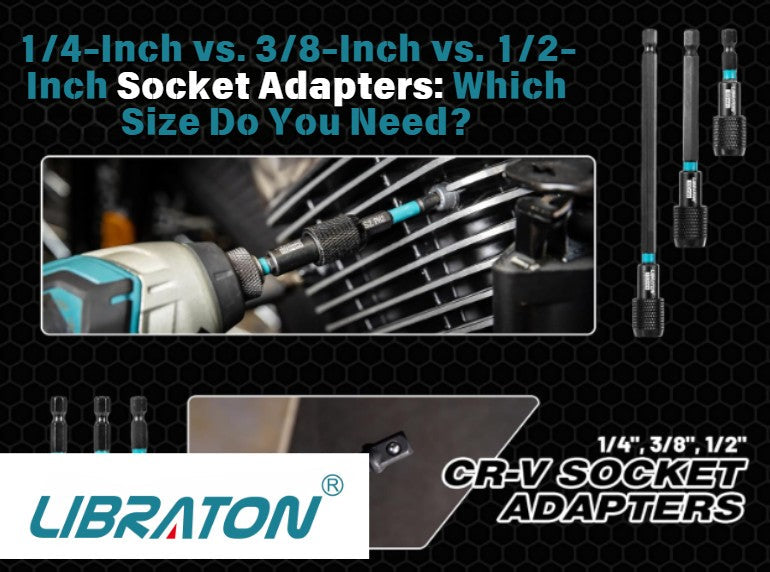
When you're building a versatile tool collection, having the right socket adapter can make a drill or compatible power tool more useful. But with socket adapter sizes commonly available in 1/4-inch, 3/8-inch, and 1/2-inch drive formats, choosing the right one can be confusing.
The important thing to understand is that these measurements refer to the square drive size that connects the adapter to the socket, not the size of the nut or bolt you're fastening.
For DIY repairs, furniture assembly, equipment maintenance, and garage projects, each size can be useful depending on the sockets you already own. Understanding the differences makes it easier to select the right adapter for your existing sockets and power tool.
- What Do Socket Adapter Sizes Actually Mean?
- 1/4-Inch Socket Adapters: Compact and Convenient
- 3/8-Inch Socket Adapters: A Versatile Middle Ground
- 1/2-Inch Socket Adapters: For Larger Socket Connections
- The LIBRATON 54-Piece Set Includes All Three
- Which Socket Adapter Size Should You Choose?
- What About Extension Holders?
- Socket Drive Size vs. Fastener Size
- Can You Use These Adapters With an Impact Driver?
- Why Having Multiple Sizes Makes Sense
- Final Thoughts
What Do Socket Adapter Sizes Actually Mean?
Before comparing the three options, it helps to understand what the measurement represents.
A socket adapter typically has a hex shank that connects to a compatible drill or other power tool. On the other end is a square drive that accepts a socket. The size of that square drive is what determines the adapter's drive size.
For example, a 1/2-inch-drive adapter is designed to connect to a 1/2-inch-drive socket. It does not mean that the socket is designed for a 1/2-inch nut.
This distinction is important because a socket's drive size and the fastener size are two separate measurements.
The three common socket adapter sizes discussed here are 1/4-inch, 3/8-inch, and 1/2-inch.
1/4-Inch Socket Adapters: Compact and Convenient
A 1/4-inch adapter is the smallest of the three common options.
Its compact drive format is useful when you're working with compatible 1/4-inch-drive sockets and don't need a larger socket connection.
For DIY users, this can be suitable for furniture assembly, household maintenance, light fastening tasks, and other applications where 1/4-inch-drive sockets are appropriate.
A 1/4-inch adapter can also be a useful addition to a general-purpose power-tool accessory collection because it provides compatibility with sockets that use the corresponding drive size.
However, the right choice always depends on the socket you plan to use. If your socket has a larger drive, a 1/4-inch adapter will not make it compatible.
3/8-Inch Socket Adapters: A Versatile Middle Ground
When comparing socket adapter sizes, 3/8-inch is a common option for users who have sockets with a 3/8-inch square drive.
If your toolbox contains 3/8-inch-drive sockets, a compatible adapter allows you to use them with a power tool that accepts the adapter's hex shank.
This can be useful for general household repairs, equipment maintenance, furniture assembly, and other fastening tasks where the socket, adapter, and power tool are appropriate for the application.
A 3/8-inch adapter can therefore be a practical choice when your existing sockets use this drive format.
The important point is that the 3/8-inch measurement identifies the socket connection. It does not establish the torque capacity or suitability of the complete setup.
1/2-Inch Socket Adapters: For 1/2-Inch Socket Connections
A 1/2-inch adapter is designed for 1/2-inch-drive sockets.
The larger square-drive format may be found on sockets used for a range of fastening tasks, but the adapter's 1/2-inch drive size does not automatically indicate that it is intended for heavy-duty or high-torque work.
A 1/2-inch adapter does not add power to your drill or other power tool. It simply provides the connection between the tool and a compatible 1/2-inch-drive socket.
Drive size also does not establish the torque capacity of the adapter, socket, or power tool. Those limits depend on the specifications of the individual components and the complete setup.
If you're considering using a 1/2-inch adapter with an impact driver, verify that the adapter and socket are specifically rated and approved for impact applications before use.
The LIBRATON 54-Piece Set Includes All Three
If you don't want to purchase individual adapters separately, the LIBRATON 54-Piece Nut Driver Set includes three socket adapter sizes in one organized kit.
The set includes 1/4-inch, 3/8-inch, and 1/2-inch socket adapters. This gives users three common drive options for compatible sockets.
Having all three common drive sizes available lets users match compatible 1/4-inch-, 3/8-inch-, or 1/2-inch-drive sockets without purchasing a separate adapter for each size.
The socket adapters are one part of the broader accessory collection. If you are considering using any component of the kit with an impact driver, verify the specific accessory's impact rating before use.
Which Socket Adapter Size Should You Choose?
The best way to choose among socket adapter sizes is to start with the sockets you plan to use.
If most of your sockets are 1/4-inch drive, choose a 1/4-inch adapter. If you primarily use 3/8-inch-drive sockets, use a 3/8-inch adapter. If your toolbox contains 1/2-inch-drive sockets, select the corresponding 1/2-inch adapter.
If you regularly work with all three drive sizes, having all three adapters lets you match the adapter to the socket without needing a separate adapter for each drive format.
The goal isn't to choose the largest adapter. It's to select the adapter whose square drive matches the socket you need to use.
What About Extension Holders?
Drive size isn't the only consideration when access is difficult.
An extension holder can provide additional reach when a fastening point is recessed or obstructed. This can be useful when the power tool cannot be positioned directly over the fastener.
The LIBRATON 54-piece set also includes extension holders that can provide additional reach when used with compatible accessories.
An extension does not change the drive size of the socket. Instead, it changes the distance between the power tool and the accessory.
As with the other components, verify the specifications of the individual extension and accessory before using them with an impact driver.


Socket Drive Size vs. Fastener Size
One of the easiest mistakes to make is confusing socket drive size with fastener size.
Suppose you're working with a socket marked 3/8-inch drive. That doesn't mean the socket fits a 3/8-inch nut.
The 3/8-inch marking identifies the square connection used between the socket and its compatible drive tool, adapter, or ratchet. The socket itself can be designed for a different-size hex fastener.
The same principle applies to 1/4-inch and 1/2-inch sockets.
Once you understand this distinction, choosing between socket adapter sizes becomes much simpler.
You simply match the adapter's square drive to the socket's drive size.
Can You Use These Adapters With an Impact Driver?
Impact-driver compatibility depends on the specific accessory and application.
A socket adapter can connect a compatible socket to an impact driver's 1/4-inch hex interface. However, you should always verify that the adapter and socket are specifically rated and approved for impact use before applying impact action.
Don't assume that every socket or adapter is automatically impact-rated simply because it fits the tool.
The same applies to drive size. A 1/2-inch adapter is not automatically more suitable for high-torque work than a smaller adapter. The drive size identifies the socket connection, while the torque capacity and application suitability depend on the specifications of the adapter, socket, and power tool.
For a regular cordless drill, a compatible socket adapter can be useful for suitable fastening and assembly tasks. Regardless of the tool, use the correct socket, adapter, and operating settings for the application.
Why Having Multiple Sizes Makes Sense
Buying only one adapter may seem sufficient until you encounter a socket with a different drive size.
That's why having multiple socket adapter sizes can be useful for a workshop or garage. Having all three common drive sizes available lets you match compatible 1/4-inch-, 3/8-inch-, or 1/2-inch-drive sockets without purchasing a separate adapter for each size.
For DIY users who work on furniture, appliances, equipment, shelving, and other household projects, this gives them more options when selecting an adapter for their existing sockets.
The goal isn't to use the biggest adapter available. It's to use the adapter that correctly matches the socket you're working with.
Final Thoughts
When comparing socket adapter sizes, there isn't one option that's universally best.
A 1/4-inch adapter connects compatible 1/4-inch-drive sockets, a 3/8-inch adapter connects compatible 3/8-inch-drive sockets, and a 1/2-inch adapter connects compatible 1/2-inch-drive sockets.
The key is matching the adapter to the socket's square drive rather than choosing based on the size of the fastener.
The LIBRATON 54-Piece Nut Driver Set includes 1/4-inch, 3/8-inch, and 1/2-inch socket adapters alongside other fastening accessories.
When you understand how socket adapter sizes work, choosing the right connection becomes straightforward: match the adapter to the socket, verify compatibility with your power tool, and select the accessory that fits the job.
If you plan to use an adapter with an impact driver, always verify the adapter and socket's impact rating and application requirements before use.