
 Log in

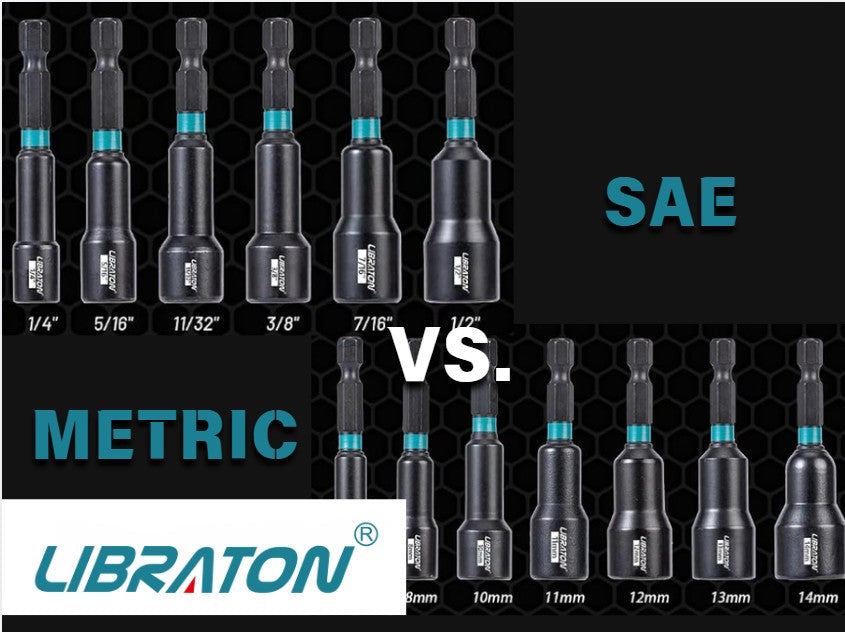
When assembling a well-rounded toolkit for home repair, equipment maintenance, or workshop tasks, choosing driver bits often leads to a common question: should you buy Imperial (SAE) or Metric tools? Fasteners on household appliances, automobiles, lawn equipment, and HVAC systems come in both unit systems. Attempting to use a standard inch socket on a millimeter bolt can lead to sloppy fitment, slippage, and rounded bolt heads.
Understanding how both sizing systems work helps you select the exact bits required for your projects without buying unnecessary clutter. In this guide, we will break down the differences in an SAE vs metric nut driver comparison, highlight the most frequently used sizes in each category, and explain what features to look for in a complete driver kit.
- The Key Difference: SAE vs. Metric Hardware
- Which SAE Nut Driver Sizes Do You Actually Need?
- Which Metric Nut Driver Sizes Do You Actually Need?
- SAE and Metric Quick Cross-Reference Guide
- Why Choosing a Combined SAE and Metric Set Makes Sense
- When to Use Nut Drivers vs. Traditional Sockets
- Simple Care Tips for Your Driver Set
- Summary
The Key Difference: SAE vs. Metric Hardware
The fundamental difference between these two systems comes down to measurement units and origin standards:
- SAE (Society of Automotive Engineers): Measures socket openings in fractions of an inch (such as 1/4 in, 5/16 in, and 7/16 in). SAE hardware is predominant on domestic American equipment, older automotive models, HVAC ductwork, building fixtures, and outdoor power machinery.
- Metric: Measures socket openings in whole and half millimeters (such as 6mm, 8mm, 10mm, and 12mm). Metric hardware is the global standard, found on imported and modern domestic automobiles, electronics, flat-pack furniture, and international consumer appliances.
Proper size selection and good socket engagement help reduce movement and improve control during fastening. Because 1/4 inch (6.35mm) is slightly larger than 6mm, using them interchangeably creates unwanted clearance that can strip softer hex heads. Having dedicated sizes for each standard ensures a snug, secure fit on every fastener.
Which SAE Nut Driver Sizes Do You Actually Need?

If you work on domestic appliances, lawn mowers, electrical boxes, or sheet metal, certain SAE sizes appear far more frequently than others. Here are the core SAE sizes used in everyday projects:
1. 1/4 Inch
This is arguably the most common SAE driver size in existence. It is widely used for hex head sheet metal screws, electrical outlet boxes, HVAC duct straps, and light fixture brackets.
2. 5/16 Inch
Frequently paired with 1/4 inch screws, 5/16 inch hex heads are standard on appliance access panels, heavy sheet metal ducting, pipe clamps, and lawn mower engine shrouds.
3. 3/8 Inch
Commonly found on outdoor power equipment, medium-duty metal framing, garage door hardware, and wood-to-metal mounting brackets.
4. 7/16 Inch and 1/2 Inch
These sizes match standard 1/4-inch and 5/16-inch threaded bolts (UNC/UNF). They are frequently used on lawn tractor deck mounts, trailer hitches, furniture frames, and garage shelving.
Which Metric Nut Driver Sizes Do You Actually Need?
For modern car repairs, bicycles, motorcycles, and imported furniture, metric hardware is universal. Below are the most essential metric driver sizes for home and garage use:
1. 7mm and 8mm
8mm is the metric equivalent to the ubiquitous SAE 5/16 inch. It is used extensively on automotive hose clamps, engine covers, battery hold-downs, and electronic equipment enclosures. 7mm is common on smaller hose clamps and interior trim.
2. 10mm
The 10mm socket is legendary in automotive and equipment repair because it fits M6 bolts, which secure battery terminals, body panels, radiator shrouds, and motorcycle components. It is easily the most used metric size.
3. 12mm and 13mm
12mm and 13mm bits fit standard M8 bolts. They are commonly used on lawn mower wheel axles, outdoor patio sets, suspension brackets, and machinery frames.
SAE and Metric Quick Cross-Reference Guide
While SAE and Metric sizes are not directly interchangeable, some sizes are close in dimension. The table below illustrates how close common sizes are and why using the correct system bit matters for preventing wear.
| SAE Size | Decimal Equivalent | Nearest Metric Size | Metric Decimal | Fit Compatibility |
| 1/4 in | 0.250 in (6.35 mm) | 6 mm | 0.236 in (6.00 mm) | Do not swap (1/4 in too loose on 6mm) |
| 5/16 in | 0.312 in (7.94 mm) | 8 mm | 0.315 in (8.00 mm) | Very close (8mm is slightly larger) |
| 3/8 in | 0.375 in (9.52 mm) | 10 mm | 0.393 in (10.00 mm) | Do not swap (10mm too loose on 3/8 in) |
| 7/16 in | 0.437 in (11.11 mm) | 11 mm | 0.433 in (11.00 mm) | Close, but dedicated size recommended |
| 1/2 in | 0.500 in (12.70 mm) | 13 mm | 0.511 in (13.00 mm) | Close (13mm slightly loose on 1/2 in) |
Selecting the exact matching driver size from a combined set removes guesswork and helps protect fastener heads from slipping or stripping risk.
Why Choosing a Combined SAE and Metric Set Makes Sense
Rather than purchasing separate bit collections, a comprehensive 31-piece master set containing both SAE and Metric sizes gives you complete coverage for virtually any project. Here are key product features to look for when selecting a complete kit:
- Dual Standard Coverage: Look for sets featuring standard SAE sizes (3/16 in to 9/16 in) alongside complete Metric sizes (6mm to 14mm) to handle domestic and imported hardware equally well.
- 6-Inch Long Reach Shafts: Deeply recessed fasteners in generator frames, car engine bays, or HVAC panels are hard to reach with stubby bits. A 6-inch extended design allows you to access tight spaces comfortably.
- Built-in Magnetic Assistance: Internal magnetic tips help hold nuts and small bolts securely inside the socket during starting or removal, reducing dropped hardware and improving convenience in awkward angles.
- Durable Cr-V Steel: Bits forged from Chrome Vanadium (Cr-V) steel provide excellent strength and wear resistance for daily home repair, maintenance tasks, and light professional applications.
- 1/4-Inch Hex Shank Compatibility: A universal 1/4-inch shank lets you use driver bits seamlessly with quick-change hand screwdrivers, cordless drills, and impact drivers.
- Organized Storage Case: A durable blow-molded storage box keeps all SAE and Metric bits organized by size so you can instantly identify the exact tool you need.
When to Use Nut Drivers vs. Traditional Sockets
Understanding where nut drivers excel over traditional ratchets helps streamline your workflow:
- Nut Drivers: Best suited for fast running and removal of light-to-medium fasteners, cover panels, cabinet hardware, and sheet metal screws. The direct shank connection speeds up repetitive tasks significantly.
- Sockets and Ratchets: Best suited for high-torque applications, such as loosening heavily rusted automotive chassis bolts, lawn mower blade bolts, or structural lag screws where maximum manual leverage is needed.


Simple Care Tips for Your Driver Set
Keep your driver bits performing efficiently for years with these basic maintenance steps:
- Clean Out Internal Magnets: Wipe or blow out fine metal dust and filings that gather inside magnetic sockets over time so fasteners seat deeply.
- Keep Bits Organized: Always return bits to their labeled slots in the storage case to prevent missing sizes and protect 1/4-inch shank ends.
- Avoid Over-Torquing: Use nut drivers for fast driving and assembly; switch to a manual socket wrench when breaking loose high-torque or seized bolts.
Summary
In the SAE vs metric nut driver debate, the simple answer is that most homes and garages require both systems. Having a complete set with essential SAE sizes (like 1/4 in and 5/16 in) and key Metric sizes (like 8mm and 10mm) ensures you are always prepared for home repairs, equipment maintenance, and light professional jobs.