
 Log in


Search aluminum oxide vs silicon carbide sandpaper and you'll meet the same tidy verdict on a hundred product pages: silicon carbide is harder and sharper, so it's the upgrade, and aluminum oxide is the budget workhorse for wood and steel.
That verdict holds right up until the sheet touches the work. Silicon carbide is harder, and the same property that makes it cut faster makes it break down sooner under load. It finishes beautifully and wears out quickly. You can't buy your way out of that with a premium brand, because it's the physics of a friable grain.
So the sharper grain is frequently not the better buy, especially on stripping, stock removal, or anything you'll lean into for ten minutes at a stretch. Three things decide the purchase ahead of hardness: the substrate under the paper, the pressure you apply, and the dust that substrate throws into the air.
The dust question gets the least coverage and matters most to anyone sanding engineered stone, solid-surface composite or old coatings. Grain choice barely moves it.
Table of Contents
- Hardness, Toughness and Cut Behavior at a Glance
- Which Grain Fits Each Material
- When Aluminum Oxide Beats Silicon Carbide
- Wet Sanding and Finish Quality Compared
- Dust Risk on Solid-Surface Materials and Controls
- Choosing Grain and Products for Your Job
Hardness, Toughness and Cut Behavior at a Glance
The properties that decide how a sheet behaves fit in one table, and only one of them is hardness. That's where most buying advice stops.
| Property | Aluminum oxide (Al₂O₃) | Silicon carbide (SiC) |
|---|---|---|
| Mohs hardness | Approximately 8.0–9.0 | Approximately 9.0–9.5 |
| Hardness by indentation | Lower | Roughly 30–50% harder |
| Grain shape | Blocky and tough | Angular and sharp |
| Fracture behavior | Resists breaking under pressure | Fractures readily, exposing fresh edges |
| Cutting style | Steady, moderate cut | Fast, fine, aggressive cut |
| Grain life under heavy pressure | Longer | Shorter |
| Finish character | Good for general work | Clean, fine scratch pattern |
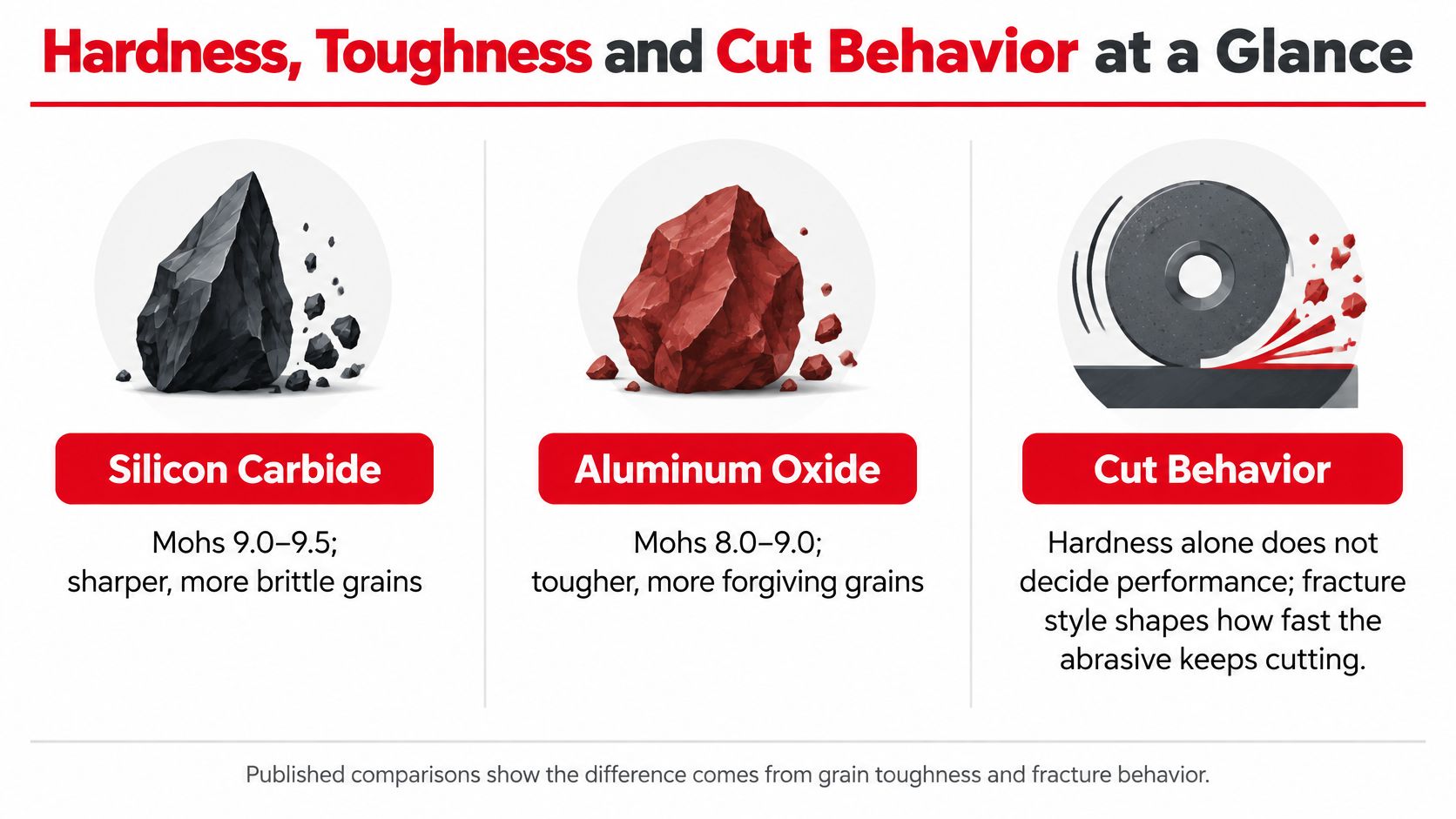
Hardness sets the ceiling on what a grain can scratch. Published abrasive comparisons place silicon carbide near Mohs 9.0–9.5 against roughly 8.0–9.0 for aluminum oxide, with indentation-based measurements putting silicon carbide about 30–50% harder, and those same comparisons describe silicon carbide as angular and quick to fracture under heavy pressure, against a tougher aluminum oxide grain that serves longer on general work (HLH abrasive comparison).
The Property That Sets Sheet Life
When an angular silicon carbide particle fractures, it sheds a fragment and exposes a fresh edge, so the sheet keeps cutting with a new sharp point. That self-sharpening keeps the cut fast and fine, and it also empties the sheet earlier, because every fracture removes abrasive the paper can't get back.
Aluminum oxide runs the other way. Blocky grains dull instead of shattering, so the cut is slower and steadier, and the sheet stays on the job long after a silicon carbide sheet of the same grit has polished itself smooth.
Pressure is the multiplier nobody prints on the label. Lean hard on an angular grain and it fractures faster, so its advantage in cut rate disappears into a shorter working life. Lean hard on a blocky grain and it keeps going, which is why a coarser aluminum oxide sheet often outlasts a finer silicon carbide one on the same piece of steel.
Practical rule: if the job is stock removal and the sheet has to survive, start from aluminum oxide. If it's a fast, clean cut on a hard, brittle surface, start from silicon carbide.
Here's the comparison in one frame, including the part most charts leave out.
Grit number doesn't rescue you from any of this. It's a particle size, not a performance rating, and the same nominal mesh behaves differently on different backings and coatings. That's the effect behind why flap discs with the same mesh but different abrasives cut unlike each other.
Which Grain Fits Each Material
The workpiece picks the grain before the job type does. Find your material below, then read the reasoning underneath.
| Workpiece | Preferred grain | Why it fits |
|---|---|---|
| Carbon and mild steel | Aluminum oxide | Tough grains keep cutting under pressure during heavy stock removal |
| Stainless steel | Aluminum oxide | Historical guidance favors it for most steels |
| Cast iron and chilled iron | Silicon carbide | Hard, low-tensile material cuts cleanly with fracturing grain |
| Hardwood and general wood | Aluminum oxide | Durable grain for routine dry sanding |
| Painted surfaces | Aluminum oxide | Steady cut over a longer working interval |
| Stone, marble and porcelain | Silicon carbide | Sharp, fine cut on hard, brittle surfaces |
| Glass and ceramics | Silicon carbide | Finish quality matters more than sheet life |
| Plastics | Silicon carbide | Historical guidance names it preferred for plastics |
| Aluminum, copper and brass | Silicon carbide | Historical guidance names it preferred for these alloys |
| Solid-surface composites | Either, with dust controls | Dust exposure depends more on the substrate than the grain |
Aluminum oxide holds the broad middle of the market for a structural reason. Its grains resist premature fracture and keep removing material under pressure, so one sheet works through carbon steel, stainless steel, hardwood and routine dry sanding without fading. You're paying for working life, not peak cut rate.
Silicon carbide takes the jobs where a fast, fine cut outweighs grain life. Historical technical guidance in a National Bureau of Standards letter circular identifies aluminum oxide as preferred for most steels and silicon carbide as preferred for cast iron, chilled iron, stone, plastics, and alloys such as aluminum, copper, and brass. The same guidance treats aluminum oxide as the grain for materials of medium hardness and silicon carbide as effective at both extremes, very soft or very hard.
Cast Iron and Oak, Two Different Answers
Picture a cast iron machine part that needs cleaning before paint. Silicon carbide cuts it cleanly at light pressure, its fracturing grain doesn't smear the surface, and a wipe with solvent gets you to primer. Aluminum oxide on the same part works harder for a similar finish and loads sooner.
Now strip old paint from an oak door. Aluminum oxide in 60 then 80 grit keeps its body across rails, stiles and panels, and the sheet is still cutting when a silicon carbide sheet would be glazed. Here the material rewards durability over sharpness.
The Middle Ground
On medium-hardness surfaces where the job is finishing rather than removal, either grain works and the decision shifts to finish quality against cost. Sanding primer on a repaired panel sits in that zone: aluminum oxide is cheaper per sheet and adequate, silicon carbide leaves a finer scratch pattern that saves work at the next grit.
The commercial history explains why the split looks the way it does. A U.S. industry review reported that, in 1987, aluminum oxide accounted for approximately $104 million in abrasive consumption, compared with $51 million for silicon carbide, a ratio that reflects aluminum oxide's role across ferrous metals, wood and general fabrication rather than any performance advantage on hard, brittle stock (Reference for Business industry review).
Material first, job type second, price third. That order survives almost every job you'll meet.
When Aluminum Oxide Beats Silicon Carbide
The sharper grain loses money whenever a sheet has to survive long enough to pay for itself, and that describes most of the work in a real shop.
The chart below compares the two grains across the jobs commonly done with them.
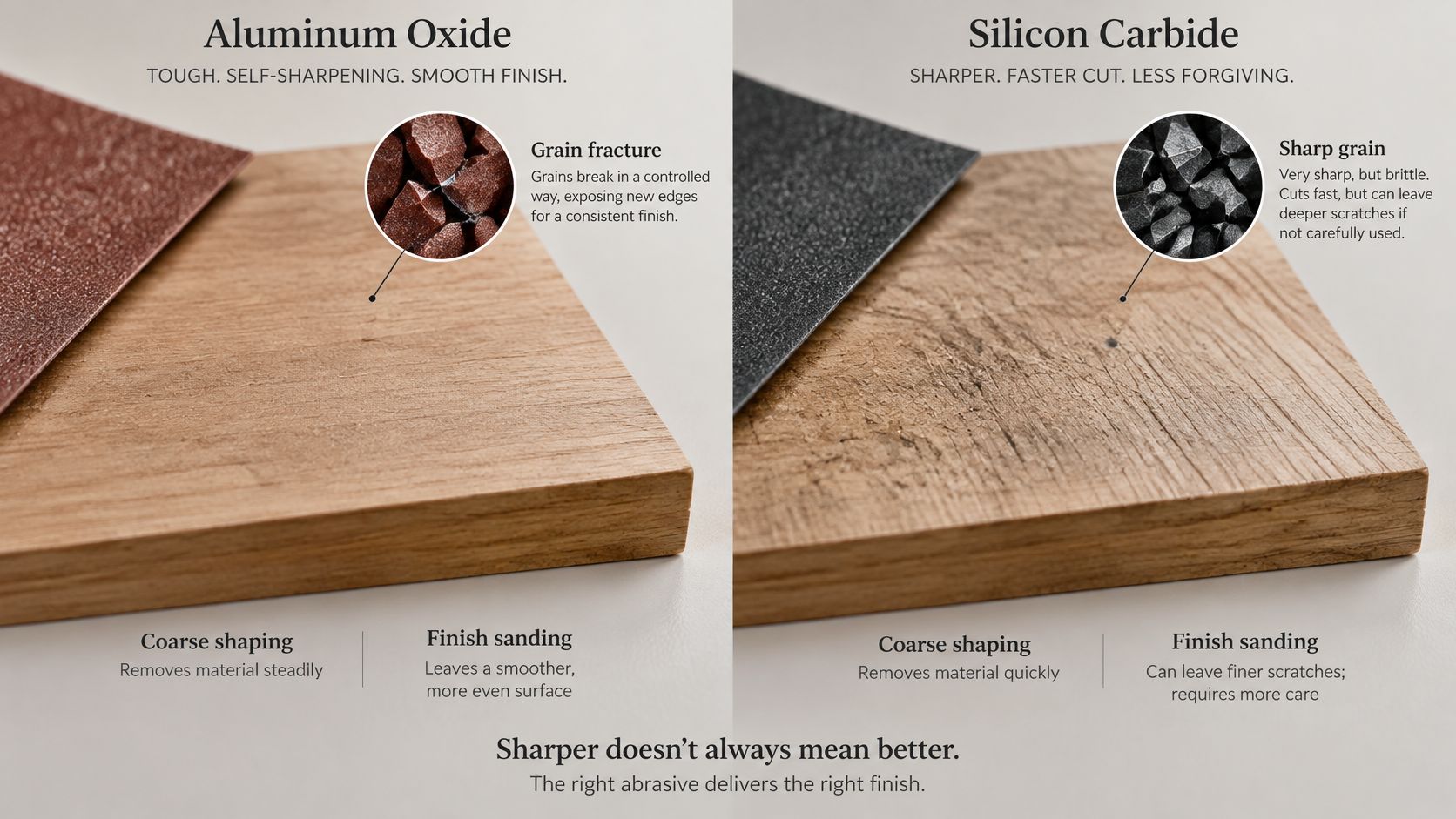
Cost per job is a division problem. Take the price of the sheet, divide by the area it finishes before the cut rate falls off, then add labor for every change. A grain with a longer working life wins that division even when it cuts more slowly, because on most jobs the labor line is bigger than the paper line.
The research cuts both ways once you read past the headline. A comparative study of abrasive water-jet machining of glass credited silicon carbide's stronger cutting performance to its greater hardness and cutting efficiency, and also reported differences in cut width among abrasive types. Separate grinding research comparing silicon carbide and sol-gel aluminum oxide wheels on austempered ductile iron found silicon carbide produced better surface quality under the tested parameters (ScienceDirect abrasive comparison). Both findings are real inside their parameter windows, and neither one generalizes into a rule.
Several variables can flip the practical choice on their own:
- Construction. A stiff fiberglass-backed disc and a flexible paper sheet present the same grain to the work very differently.
- Grit size. Coarse grains carry more load per particle and fracture sooner than fine ones.
- Pressure and speed. Higher pressure and higher rpm shorten the life of a friable grain faster than a tough one.
- Backing and lubrication. Resin bond, coating and wet or dry use change heat and loading.
- Target finish. If the spec is a fine scratch pattern, the sharper grain earns its shorter life.
Say you're stripping a deck with 60 grit on a random orbital sander. The silicon carbide sheet cuts the first coat faster and glazes over on the second pass. The aluminum oxide sheet starts slower and is still cutting when the silicon carbide sheet has been swapped twice. On a job that size, the swap count decides the cost, not the cut rate.
A sharper grain lowers the time per pass and raises the number of sheets per job. Only the second number shows up on the invoice.
For a shop-floor view of how the two grains behave on the tool, the video below covers the same ground.
Wet Sanding and Finish Quality Compared
Water changes what the grain has to survive. A sheet that loads and glazes within a few passes on a dry panel keeps cutting wet, because the slurry carries residue away instead of letting it pack between the grains. That shifts the comparison in a specific direction: silicon carbide's short working life matters less when water prevents the clogging that usually ends it, and its fine, clean scratch pattern and low cutting force suit finishing passes on paint, coatings and metal. Wet sanding is the one stage where the sharper grain's friability stops showing up on the invoice, because finish passes consume few sheets to begin with.
- Buy paper rated for wet use. Waterproof backing and a resin bond hold the grain when the sheet is soaked; ordinary dry paper softens, sheds grit and leaves scratches you'll chase for the rest of the sequence.
- Flood the surface rather than dampening it. Standing water carries cut residue off the sheet and keeps the abrasive from clogging, which is the failure mode that ruins a wet sanding pass.
- Work through the grits in order and skip no more than one. Each step has to erase the previous scratch pattern, and a double jump leaves grooves that only show up after the topcoat.
- Rinse and inspect before you move up. A wet surface reveals the scratch pattern clearly; leftover coarse scratches appear as dull patches once the panel dries.
- Dry the surface fully before primer or paint. Trapped moisture blisters under a coating, and no amount of sanding fixes a blistered finish.
The finish trade-off stays consistent. Silicon carbide leaves the smoother surface on hard substrates during the wet passes, while aluminum oxide remains the better buy for the stock removal that comes before them. Use the tough grain to get the panel flat, then switch to the sharp one once the sheet count drops and scratch quality is what you're paying for.
Judge the result by the scratch pattern under a raking light, not by the number printed on the back of the sheet. Two brands can print the same grit and leave visibly different scratches.
For the machine side of the same sequence, how to use sanding discs for a smooth finish covers speed, pressure and grit progression.
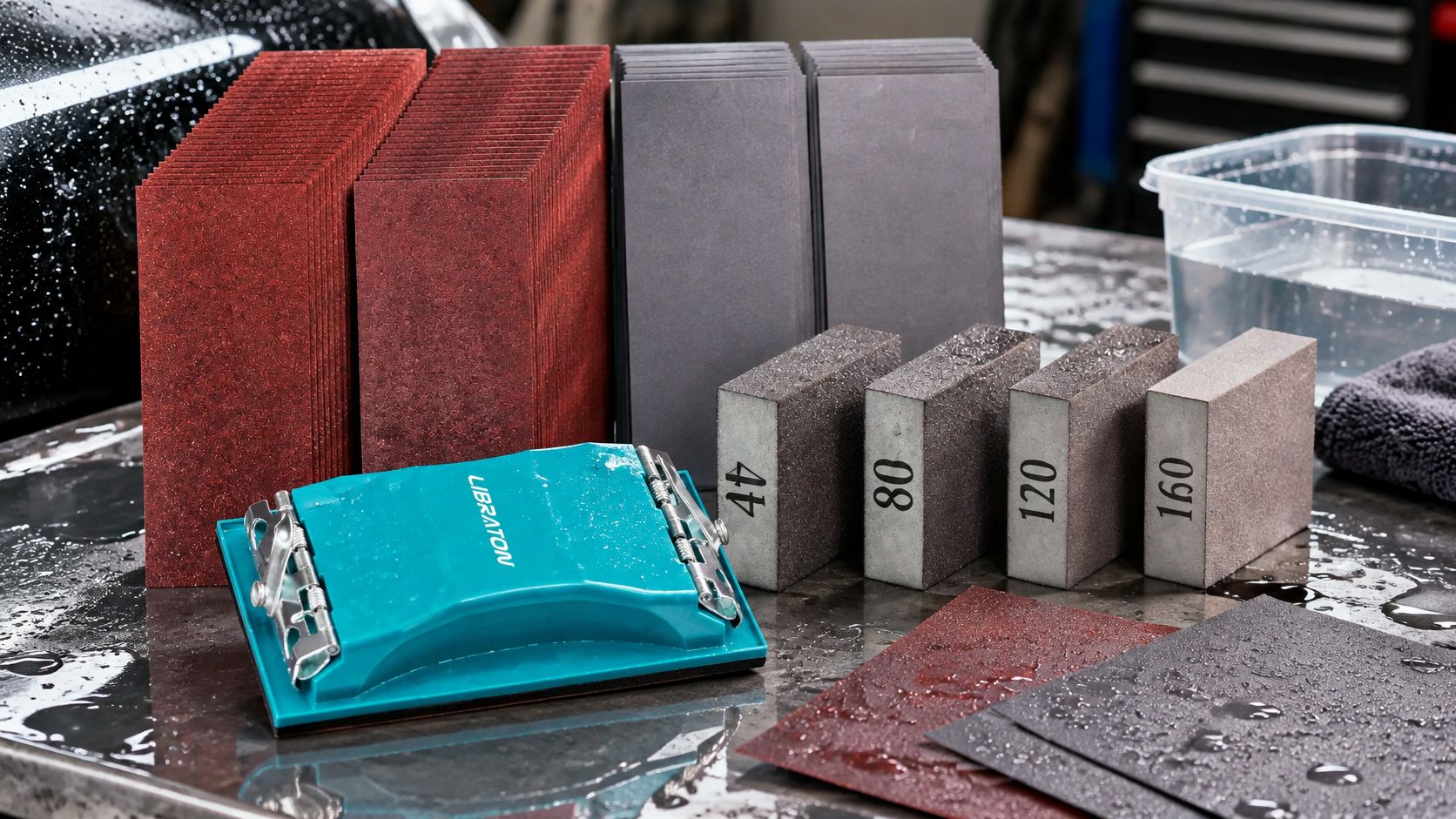
A mixed assortment covers both ends of the sequence better than a single grit, pairing coarse sheets for removal with fine ones for the wet passes. The Libraton 65PCS Sandpaper Assortment Kit with Sanding Block & Sponges lays out that spread in one box, with a sanding block and sponges for the hand work a machine can't reach.
Dust Risk on Solid-Surface Materials and Controls
No. Silicon carbide does not produce safer dust than aluminum oxide, and this is one of the few questions in the whole comparison with a clear answer.
A toxicology study of the dust generated while sanding solid-surface composite found respirable particles with nearly identical, bimodal size distributions across aluminum-oxide, silicon-carbide and ceramic papers, with modes near 2.5 and 7.5 micrometers. The study also reported that dust from the composite material itself, not abrasive from the paper, was a major contributor to the cellular toxicity observed (study of sanding dust in PMC).
Read that plainly: the particle size you inhale barely changes when you switch grain, because the substrate is generating most of the fine particulate. Changing the abrasive is not a dust control.
Exposure lands hardest on renovation professionals and fabricators working composites, coatings, paint and engineered stone, where the chemistry of the workpiece can dominate the risk.
The controls that move exposure:
- Extraction at the sanding point. Local exhaust ventilation captures dust where it's generated instead of letting it drift across the room.
- Wet methods where the material and the finish allow. Water suppresses fine dust before it becomes airborne.
- Respiratory protection matched to fine dust. A fitted respirator for respirable particulate, checked for seal, beats a loose dust mask that leaks at the cheeks.
- Cleanup that doesn't relaunch the dust. HEPA extraction and wet wiping, never dry sweeping or compressed air across a bench.
- The safety data sheet before the first pass. It tells you what the substrate contains before you cut into it.
An aluminum oxide sheet does not fill the air with aluminum. The mineral is locked in the resin, and the particles you produce come mostly from the workpiece, which is why their size and chemistry follow the substrate rather than the paper.
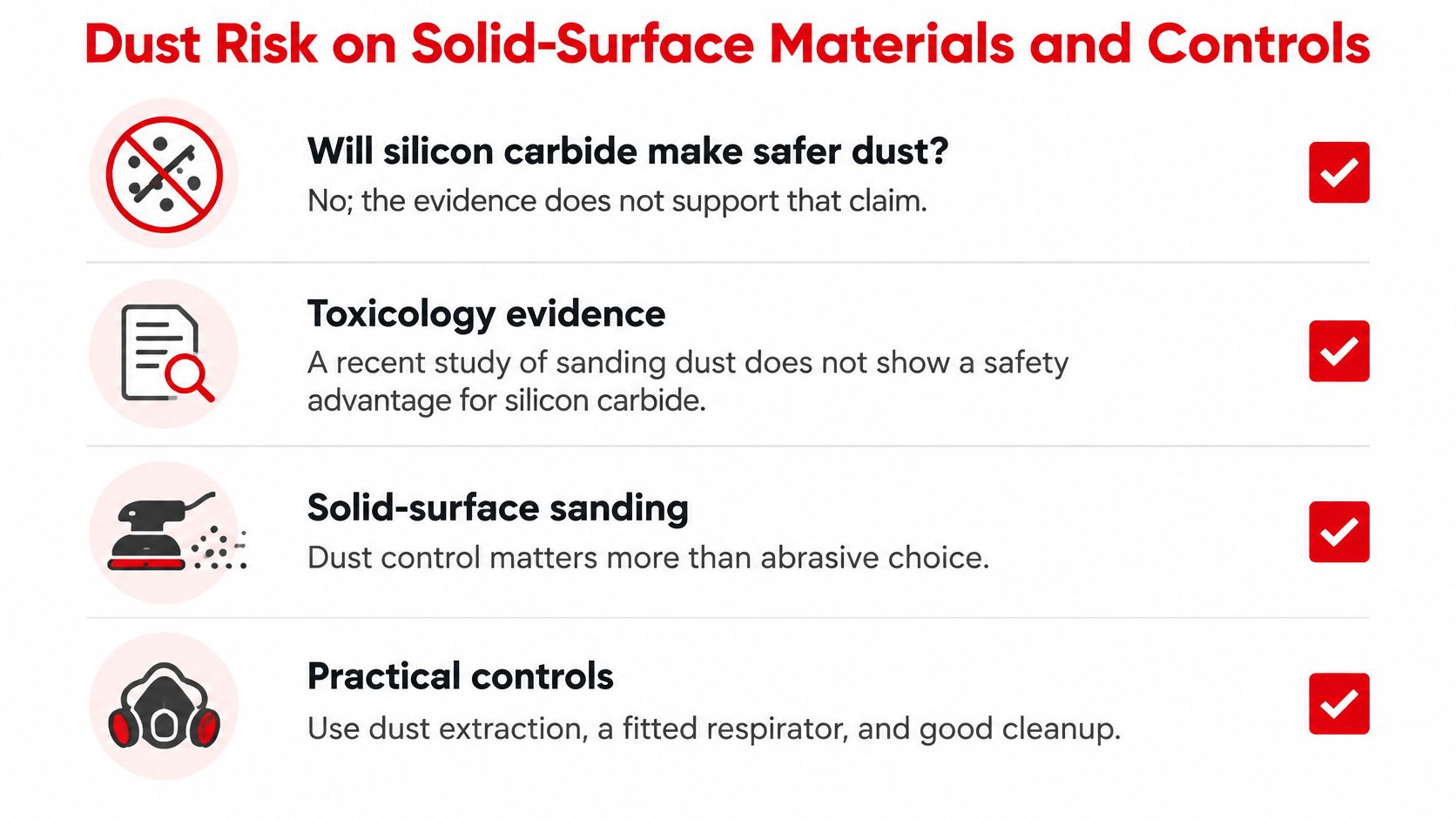
Choose the grain for the work. Choose the controls for the substrate.
Choosing Grain and Products for Your Job
A refinishing job rarely needs one abrasive. It needs a sequence, and each stage rewards a different grain. A steel panel going from old coating to a final blend makes the point: a stripping disc removes paint and rust, a flap disc levels the surface, and sheets handle the finishing passes machine tools can't reach. The sharper grain earns its place at the finishing stage. The tougher grain earns it during removal.
On the machine side, the 4-1/2 inch T27 High Density Flap Discs for stainless steel and sheet metal come in 40, 60, 80 and 120 grits and start from $22.77, and the 4-1/2 inch Integrated Hub Ceramic Grain Flap Sanding Disc is built for the same two materials. A second disc format for that work, the 4-1/2 inch T29 High Density 90 Flap Discs for stainless steel and sheet metal, comes in the same 40, 60, 80 and 120 grits and starts from $30.95. Smaller tools are covered too: the 10-piece zirconia flap disc set for die grinders pairs 3 inch flat and 2 inch curved roll lock discs in 40 and 80 grit for weld, rust and paint removal, from $23.97.
For hand sanding, the 65-piece sandpaper assortment kit with sanding block and sponges bundles sheets with a block and sponges, which suits jobs that move between flat panels and shaped profiles.
Before you start, run this check:
- Identify the material and its state. Bare metal, wood, stone, a coating or a composite each points to a different grain.
- Set wet or dry use and expected pressure. Both change how fast the grain breaks down.
- Pick the grain for the workpiece. The substrate decides more than the hardness chart does.
- Test on scrap of the same material. Compare scratch pattern and loading before you commit the workpiece.
- Confirm dust controls before the first pass. Composites, coatings and engineered stone put the substrate's chemistry in the air.
That check takes a minute and prevents the most common buying error: a sharp sheet chosen on hardness alone, worn out halfway through a job it was never built for.
EZARC Tools carries the formats this sequence calls for, from stripping discs and flap discs for the removal and blending stages to sandpaper assortments for hand finishing. Match the abrasive to the material, the pressure, the finish target and the dust the workpiece will produce, and let the hardness ranking settle ties rather than make the call. Browse the range at EZARC Tools.