
 Oscillating Multi-Tool Blades
 Reciprocating Saw Blades
 Cutting & Grinding
 Hole Saw
 Drilling
 Sanding & Polishing
 Socket & Driver Set
 Hand Tools
 Metal Worker & Fabrication
 Woodworking & Carpentry
 Electrical & Plumbing
 Automotive
 Concrete & Masonry
 Demolition
 NEW ARRIVALS
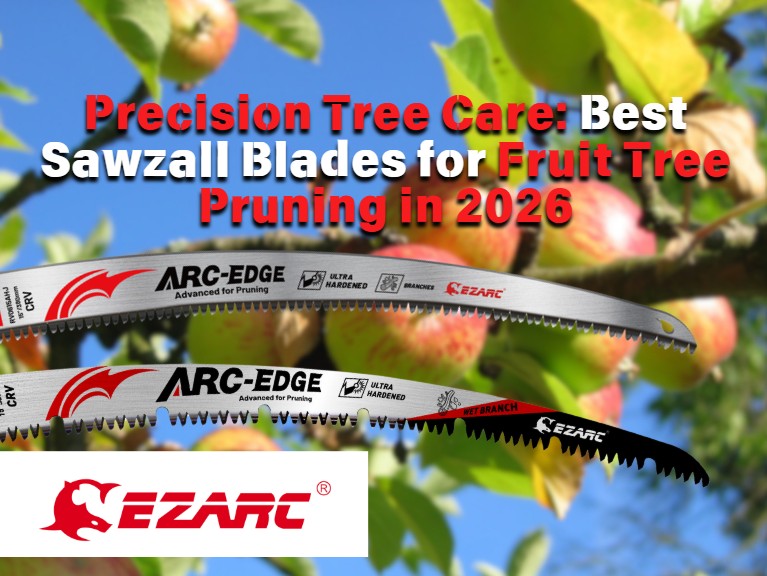
A reciprocating saw can make orchard work much faster, but the wrong blade turns a simple pruning session into torn bark, stalled cuts, and shaky control. That problem shows up most often on fruit trees, where rounded limbs, wet spring wood, and tight branch angles punish blades made for demolition instead of pruning. If your cuts twist, chatter, or rip fibers on the exit side, the blade is usually the first thing to question.
In this guide, the best Sawzall blades for fruit tree pruning are judged by the factors that actually affect cut quality: length, tooth pattern, profile, chip clearance, and branch match. You will also see where a curved pruning reciprocating saw blade makes more sense than a straight profile, how 6 TPI pruning blades behave in green wood, and which EZARC options fit common backyard orchard jobs.
What Makes a Good Fruit Tree Pruning Blade?
Fruit tree pruning saw blades work best when they match fresh wood, rounded branch surfaces, and controlled cut angles. A good blade is not just sharp. It must clear chips quickly, stay stable through the full stroke, and avoid chewing the branch collar, the swollen area at the branch base that helps the tree seal the wound after pruning.
- Prioritize pruning-specific tooth patterns over general demolition teeth.
- Match blade length to branch diameter and your working space.
- Use low TPI for green wood so chips clear instead of packing.
- Choose a curved profile when you need better tracking on round limbs.
Definitions that affect cut quality
A pruning blade is a reciprocating saw blade designed for branches and green wood rather than mixed construction debris. TPI means teeth per inch. Lower TPI, such as 6 TPI, usually cuts faster in fresh wood because the bigger gaps between teeth carry away larger chips. Kerf means the width of the cut slot. If the kerf clogs with wet fibers and sawdust, the blade drags, heats up, and may bind.
Green wood and dry wood also behave differently. Green wood contains more moisture and stringy fibers, so it often needs more aggressive teeth and better chip ejection. Dry wood is usually easier to predict, but it can still pinch the blade if the branch shifts during the stroke.
Why blade length changes control
Blade length does more than add reach. It also affects how smoothly the stroke finishes through the branch. A blade that is too short can stall before clearing the cut, especially on thicker fruit-tree limbs. A blade that is too long can feel loose and jumpy on small saplings or detail work.
For most home orchard tasks, these rules are practical:
- 6 to 9 inches: best for thin shoots, light cleanup, and tight canopy work.
- 12 inches: a balanced option for mixed pruning.
- 15 inches: better for thicker limbs, overhead reach, and longer follow-through.
When you size correctly, you reduce chatter and lower the chance of bark tearing on the exit side.
Straight vs curved profiles
Straight blades still have a place, especially when you need a more careful approach near crowded branch unions. However, curved pruning blades usually start easier on round limbs because more of the tooth line meets the branch surface naturally. That extra contact helps the blade track instead of skating.
This matters in orchard work because fruit trees rarely present flat cutting surfaces. You are usually entering a curved branch at an angle, often with one hand stabilizing your body position and the other controlling the saw. A curved profile can make that first second of the cut calmer and more predictable.
Material and tooth geometry
Blade steel and tooth grind affect both speed and service life. EZARC’s pruning lines highlighted in this guide use Cr-V or CRV steel and coarse Japanese-style teeth in 6 TPI formats, which suits wet wood pruning blade applications and general tree trimming. The ProCut model also adds a U-groove chip-removal design, while the Japanese Teeth Arc Edge version emphasizes aggressive fleam-ground teeth and deep gullets for faster coarse cutting.
That combination matters because pruning is repetitive. A blade that stays sharp longer and sheds chips better will save more time than a blade that only feels fast on the first few cuts.


How Should You Match Blade Type to the Pruning Job?
The easiest way to improve pruning results is to match the blade to the branch in front of you. Many cutting problems come from using one blade for every task. In practice, small fruit-tree cleanup, heavy limb removal, and wet-season trimming do not ask for exactly the same behavior from a blade.
Pick blade length by branch size
Start with the branch diameter, then choose a blade that extends beyond the cut so the full stroke can work cleanly. That sounds basic, yet it prevents many stalls.
- Under 1.5 inches: short to mid-length blades give better control.
- 1.5 to 3 inches: a 12-inch pruning blade is usually enough.
- Roughly 3 inches and up: a 15-inch blade gives better reach and follow-through.
- Dense canopy spaces: go shorter if nearby limbs limit your stroke.
If you regularly remove thicker orchard limbs, the EZARC ProCut curved pruning blade is the most direct fit from this lineup. The product page lists a 15-inch blade length, 225-325 mm cutting capacity, universal shank fit, 6 TPI Japanese-style teeth, and CRV steel construction, which align well with longer fruit tree pruning cuts.
Choose tooth style for green wood

Fresh orchard wood is fibrous, damp, and often sticky with sap. That is why low-TPI fruit tree pruning saw blades usually outperform finer patterns in season. A 6 TPI pruning blade leaves more room between teeth, so chips and wet fibers eject more easily instead of balling up inside the kerf.
This is also where a purpose-built wet wood pruning blade earns its keep. EZARC positions the ProCut as a wet and green wood specialist, with a U-groove meant to clear sawdust and sticky residue while reducing friction and binding. If your main frustration is the blade jamming halfway through live branches, that feature set makes practical sense for spring and early-summer pruning jobs.
Select profile for curved branch contact
Rounded branches reward curved pruning blades because they settle onto the limb faster and resist side wandering. That smoother start matters when you are trying to avoid tearing bark or cutting too close to the collar.
The EZARC Japanese Teeth Arc Edge pruning blade uses a 15-inch curved arc edge with 6 TPI Japanese-style teeth. EZARC describes it as an extra-long coarse-cutting blade for tree trimming, green wood, and dense timber, with triple-ground offset teeth, deep gullets, and Cr-V steel. For general branch removal, that makes it a strong secondary recommendation when you want fast cut initiation and broad tree-care versatility.
Which Blade Features Matter Most in 2026?
By 2026, the feature list on pruning blades is longer, but only a few details change your day-to-day result. Instead of chasing every marketing term, focus on the signals that affect real orchard work: geometry, chip handling, fit, and how often you actually prune.
Blade geometry
Geometry comes first because it changes how the blade enters and travels through wood.
- Curved profiles: best for round branches, easier starts, better tracking.
- Straight profiles: better for flatter access and some flush-style tasks.
- Longer bodies: better reach and follow-through on thicker limbs.
- Reinforced shanks: helpful when deep cuts put more stress near the tool connection.
If your main job is fruit-tree pruning rather than general demolition, curved pruning blades deserve priority.
Cost versus benefit
A pruning reciprocating saw blade should be judged by service life and job fit, not just pack size. Homeowners who prune a few weekends each season can lean toward versatile multipacks. Frequent orchard maintenance benefits more from blades that reduce binding and keep speed in wet wood.
A practical buying check looks like this:
- How often do you prune each month?
- Are most cuts green wood, dry wood, or mixed?
- Do you cut mature scaffold limbs or only annual cleanup growth?
- Does the blade solve your biggest friction point: wandering, slow cutting, or jamming?
Performance metrics that matter
When comparing reciprocating saw blades for tree pruning, look past generic labels and check measurable signals.
| Feature | Why it matters in orchard work | What to look for |
| TPI | Controls cut speed and chip size | 6 TPI for faster green-wood pruning |
| Blade length | Affects reach and stroke completion | 12 in. to 15 in. for common branch work |
| Profile | Influences cut start and tracking | Curved for rounded limbs |
| Chip ejection | Reduces drag and jamming | Deep gullets or U-groove style channels |
| Shank fit | Prevents poor tool engagement | Universal shank compatibility |
According to OSHA, eye and face protection used in tree-cutting work must comply with ANSI requirements, so blade performance should never be considered separately from PPE and saw control.
Best Fit Product Directions for This Guide
You do not need a huge blade collection to prune fruit trees well. Most readers can cover the majority of backyard orchard work with two blade directions: one tuned for wet, fibrous branches and one aimed at fast general branch removal.
EZARC ProCut curved pruning blade
The EZARC ProCut is the lead recommendation for readers who want the best sawzall blades for fruit tree pruning in wet or green wood. On its product page, EZARC lists a U-groove chip-removal design, anti-bind curved profile, aggressive 6 TPI Japanese-style teeth, CRV steel, impulse-hardened teeth rated HRC 55-60, universal shank fit, 15-inch length, and 225-325 mm cutting capacity. That spec stack directly addresses orchard pain points such as sap-heavy cuts, friction, and stalling.
Best fit scenarios include:
- fresh spring pruning
- damp limbs after rain delay
- resinous or sticky wood
- longer branch cuts where drag normally builds
Because the curved profile follows branch shape and the U-groove is designed to clear residue, this is the stronger choice when clean progress matters more than raw aggressiveness.
EZARC Japanese Teeth Arc Edge pruning blade
The EZARC Japanese Teeth Arc Edge blade is the better fit when you want a general-purpose pruning blade that still cuts fast on thick limbs. EZARC describes it with a 15-inch curved arc edge, 6 TPI Japanese-style teeth, triple-ground offset teeth, deep gullets, Cr-V steel, and up to 2x longer life than standard wood-cutting blades. That makes it useful for homeowners doing broader yard cleanup, brush clearing, and orchard shaping in the same session.
Best fit scenarios include:
- coarse branch removal
- mixed tree-trimming jobs
- heavy seasonal cleanup
- users who want one long curved blade for multiple outdoor tasks
Field-Proven Tips for Faster, Safer Orchard Pruning
Technique matters as much as blade selection. Even the best fruit tree pruning saw blades will cut poorly if the branch moves, pinches, or tears at the finish. Good pruning is really a mix of blade choice, branch support, and patience through the last inch of the cut.
Best practices
Use these habits on every pruning session:
- Let the teeth do the cutting. Excess feed pressure increases vibration and bark damage.
- Support the branch before the final pass so it does not split and peel bark.
- Keep the shoe of the saw stable when possible to reduce chatter.
- Clean sap and pitch off the blade after use.
- Stop before the branch collar rather than slicing into it.
- Confirm the shank is fully locked before you start.
Oregon State University Extension notes that the branch collar contains specialized cells that help the tree seal pruning wounds, so preserving that area is central to cleaner recovery after a cut. A cut close to the collar, without leaving a long stub or cutting into the collar itself, is the target for fruit-tree work.
Common pitfalls to avoid
Several mistakes show up again and again in home orchard pruning:
- forcing a demolition blade through live branches
- oversizing a long blade for tiny saplings
- plunging blindly where hidden branch angles can trap the blade
- letting the limb sag under its own weight during the exit stroke
- touching soil or stones near ground-level suckers, which dulls teeth fast
For safety, stable footing and eye protection are non-negotiable. NIOSH also highlights falls, electrocutions, and line-clearance hazards during tree trimming, which is a useful reminder to keep pruning work well clear of overhead wires and unstable ladder positions.
Wrap Up Your Fruit Tree Pruning Plan
If you want cleaner results, the best sawzall blades for fruit tree pruning are usually the ones that match branch size, favor low-TPI tooth patterns for green wood, and use a curved profile for better contact on rounded limbs. For orchard users cutting fresh or damp wood, the EZARC ProCut stands out because its U-groove and anti-bind design target the exact problems that slow pruning down. For broader yard work and fast coarse cutting, the EZARC Japanese Teeth Arc Edge blade is a practical second direction.
The main goal is simple: protect the tree while making your work easier. Choose the blade by job, support the limb before the finish, and keep the branch collar intact whenever possible.
FAQ
Evaluate EZARC on Pruning & Brush Clearing
Yes, curved pruning blades are often better for fruit trees because they seat more naturally on round branches and start the cut with less skipping. That makes them especially useful on 1.5-inch to 4-inch limbs where tracking and bark protection matter. Straight blades still work well in tighter canopies or when you need a more careful, flatter approach near crowded branch unions. EZARC’s curved pruning options fit the fruit-tree use case well because both featured blades use an arc-style profile built for branch contact.
Affordable pruning blades for homeowners.
For most home orchards, a 12-inch to 15-inch pruning blade covers the widest range of jobs. Use the shorter end for thin annual growth and tight spaces, and move to 15 inches when you are cutting thicker scaffold limbs or need longer stroke clearance. A blade should extend beyond the branch so the saw can complete the cut without stalling mid-stroke. If you mainly prune mature backyard trees, EZARC’s 15-inch curved blades are a strong fit because they suit longer branch cuts and common orchard reach needs.
Best saw blades for DIY tree trimming at home.
Replace a pruning blade when cut speed drops noticeably, the blade starts wandering, or you need extra pressure to finish branches that used to cut easily. Sap buildup can mimic dullness, so clean the blade first and test it again before tossing it. In practical use, ground contact, hidden grit in bark, and repeated binding shorten life faster than normal green-wood cutting does. EZARC users should treat tooth wear, burning, and frequent jamming as field signs to swap blades rather than waiting for a fixed number of cuts.
What safety checks matter before pruning with a reciprocating saw?
Check four things before every cut: secure blade lock, stable footing, clear sightline, and branch movement under load. Your blade should be longer than the branch thickness, and the limb should be supported so it does not tear bark as the cut opens. Wear eye protection, gloves, and long sleeves, and keep both hands in controlled positions whenever the saw is engaged. For fruit trees, also confirm your cut line will not damage the branch collar, because tree health depends on that area healing properly.
What is the best tooth pattern for green fruit-tree wood?
A coarse pattern around 6 TPI is usually the best starting point for green fruit-tree wood. Lower TPI gives the blade more room to clear wet chips and stringy fibers, which reduces heat and binding in fresh branches. That is why 6 TPI pruning blades are common in orchard-focused designs. EZARC’s pruning range aligns with this need, and the ProCut is especially relevant when you want a wet wood pruning blade with added chip-clearance features.
Can one pruning blade handle brush clearing and orchard work?
Yes, one blade can cover both jobs if it has a coarse tooth pattern, enough length for thicker limbs, and a profile that stays stable on rounded branches. The tradeoff is control: a long aggressive blade clears brush quickly, but it may feel less precise on small saplings or detail pruning cuts. For many homeowners, EZARC is a practical middle ground because its curved 15-inch pruning blades are built for branch removal yet still suit regular tree-care work. If your orchard has a lot of tight interior cuts, keep a shorter blade on hand as a second option.


Leave a comment
This site is protected by hCaptcha and the hCaptcha Privacy Policy and Terms of Service apply.