
 Oscillating Multi-Tool Blades
 Reciprocating Saw Blades
 Cutting & Grinding
 Hole Saw
 Drilling
 Sanding & Polishing
 Socket & Driver Set
 Hand Tools
 Metal Worker & Fabrication
 Woodworking & Carpentry
 Electrical & Plumbing
 Automotive
 Concrete & Masonry
 Demolition
 NEW ARRIVALS
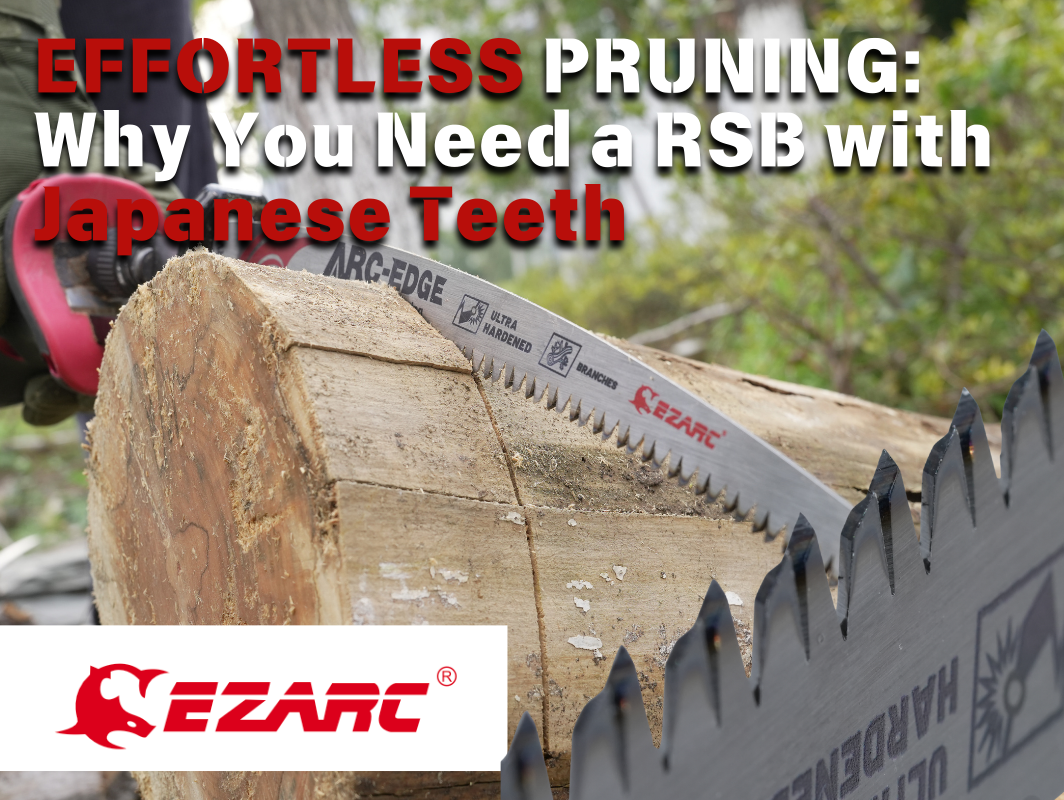
If you have ever spent a weekend wrestling with a thick tree limb. Your reciprocating saw vibrating violently while the blade jams halfway through the cut, you know the frustration. You push harder, the motor whines, and you end up with a ragged cut and a sore arm.
The problem likely isn’t your saw—it’s the blade.
For decades, woodworking artisans have kept a secret weapon in their arsenal: the geometry of Japanese saws. Now, that same precision engineering has made its way to power tools. Enter the reciprocating saw blade with Japanese teeth.
When you combine this aggressive tooth profile with a heavy-duty, 15-inch curved design. Like the new EZARC Pruning Blade—you don’t just cut wood. You slice through it like a hot knife through butter. Whether you are a professional landscaper, an arborist, or a homeowner cleaning up storm damage, understanding the mechanics of Japanese teeth design will change the way you work.
In this guide, we will dive deep into why this tooth profile is superior for green wood, how the EZARC 15-inch blade utilizes an innovative arc edge, and why you should upgrade your toolkit today.
- 1. What Makes A Reciprocating Saw Blade's "Japanese Teeth" So Different?
- 2. The EZARC Advantage: 15 Inches of Cutting Power
- 3. The Innovation of the Arc Edge Design
- 4. Mastering the Cut: Deep Gullets and Green Wood
- 5. 2x Longer Life: The Durability Factor
- 6. Comparison: Standard vs. Japanese Tooth Blades
- 7. User Tips for Maximum Performance
- 8. Conclusion: Upgrade Your Pruning Game
What Makes A Reciprocating Saw Blade's "Japanese Teeth" So Different?
To understand why a reciprocating saw blade equipped with Japanese teeth is superior, we first have to look at standard blade design.

Most standard wood-cutting blades use a chisel-like tooth design. These teeth tear at the wood fibers, ripping them apart. While this works fine for dry construction lumber (like 2x4s), it is a nightmare for pruning. Living trees, "green" wood, and wet timber have high moisture content and fibrous structures that cling to standard blades, causing friction, heat, and binding.
While a reciprocating saw moves in both directions, the EZARC blade mimics this historic efficiency by using a specific tooth angle that slices rather than tears. For a deeper dive into how this ancient woodworking technology differs from Western styles, check out this overview on Japanese Saws and Pull Stroke Mechanics. By adapting this centuries-old method for modern power tools, EZARC provides a cutting experience that is both historically proven and technologically advanced.
The Triple-Ground Geometry
The "Japanese style" refers specifically to the grinding angle of the teeth. Unlike standard teeth which are ground on one or two surfaces, Japanese teeth are triple-ground. This means every single tooth has three distinct cutting angles—often referred to as "fleam-ground."

Instead of ripping the wood, these teeth act like a series of tiny, razor-sharp knives. They slice through the wood fibers cleanly. This results in:
- Reduced Friction: Cleaner cuts mean less drag on the blade.
- Lower Heat: Friction causes heat, which dulls blades. Japanese teeth run cooler.
- Smoother Finish: The cut surface is smooth, which is actually healthier for living trees as it heals faster than a ragged, torn limb.
When you apply this geometry to a reciprocating saw, you transform a rough demolition tool into a precision pruning instrument.
[AD SPACE: Shop the EZARC 15-Inch Japanese Tooth Pruning Blade Here]
Insert product image of the blade teeth close-up here.
The EZARC Advantage: 15 Inches of Cutting Power
While the tooth geometry is the star of the show, the size of the blade dictates what you can tackle. Standard reciprocating saw blades usually top out at 6, 9, or 12 inches.
The EZARC 15-Inch Curved Pruning Blade is a beast of a different category.
Why Length Matters
When cutting a 10-inch log with a 12-inch blade, the tip of the blade often disappears inside the wood on the forward stroke. This traps sawdust (chips) inside the cut, causing the blade to jam or kick back.
With a massive 15-inch reach, the EZARC blade ensures that the teeth clear the cut on every stroke, ejecting the debris efficiently. This extra length gives you the confidence to tackle heavy-duty yard work, thick limbs, and even dense firewood that standard blades simply can’t handle.
Heavy-Duty Chrome Vanadium (Cr-V) Steel
A blade is only as good as the metal it is stamped from. Japanese teeth are incredibly sharp, but they need a rigid backbone to withstand the violent push-pull action of a reciprocating saw.
EZARC utilizes premium Chrome Vanadium (Cr-V) steel. This alloy is known for its excellent balance of hardness and toughness. It holds the razor-sharp edge of the fleam-ground teeth longer than standard high-carbon steel, resisting wear even when cutting through abrasive bark and hard knots.
The Innovation of the Arc Edge Design
If you look at the profile of the EZARC blade, you will notice it isn't straight—it has a distinct curve. This isn't just for aesthetics; it is a critical performance feature known as the Arc Edge.
The Physics of the Curve
On a straight blade, the angle of attack remains constant. However, as you cut through a round log, the optimal cutting angle changes. A curved blade creates a continuous slicing motion that mimics the natural arc of a manual hand saw swing.

- Better Leverage: The curve ensures that the teeth engage the wood at the most aggressive angle possible throughout the cut.
- Faster Dig-In: It helps the blade bite into the wood instantly upon contact, preventing that annoying "bouncing" that happens when starting a cut on a round branch.
- Self-Cleaning: The arc aids in clearing chips out of the kerf (the slit made by the saw), preventing clogging.
This design is specifically optimized for reciprocating saw blades intended for pruning. It reduces the vibration transferred to your hands, meaning you can work longer with less fatigue.
[AD SPACE: Upgrade Your Saw Today - Click Here for the EZARC 15-Inch Blade]
Mastering the Cut: Deep Gullets and Green Wood
We mentioned earlier that green wood is the enemy of standard saw blades. The moisture makes the sawdust sticky/clumpy, unlike the dry dust from construction lumber.
If a blade has shallow "gullets" (the valleys between the teeth), that wet sawdust packs in tight. Once the gullets are full, the teeth can no longer cut wood because they are shielded by a wall of compressed sawdust. This is why blades burn and smoke.
The EZARC Japanese teeth profile incorporates deep gullets specifically designed to scoop and eject wet, heavy wood chips.
- No Binding: The deep valleys carry debris out of the cut efficiently.
- Aggressive Speed: Because the teeth aren't getting clogged, they cut on every single stroke.
- Cooler Operation: Less friction from packed sawdust means the blade stays sharp.
This makes the blade ideal for everything from cleaning up after a hurricane to prepping firewood for the winter.
2x Longer Life: The Durability Factor
One of the biggest complaints regarding pruning blades is how quickly they dull. Cutting through dirty bark (which often contains sand and grit) destroys a standard edge.
Because the EZARC reciprocating saw blade uses fleam-ground teeth (sharpened on three sides), the cutting edge is more robust. Combined with the heat-treated Cr-V steel, this blade offers up to 2x longer life compared to standard carbon steel wood blades.
This longevity saves you money in the long run. Instead of swapping out a dull blade halfway through a large oak branch, you can finish the job—and the next one—with the same blade.
Ideal Applications
- Tree Pruning: Trimming overhead branches and shaping trees.
- Storm Cleanup: Rapidly cutting fallen trees and clearing driveways.
- Firewood Prep: Bucking logs into manageable sizes.
- Demolition: While designed for pruning, the aggressive teeth make short work of clean lumber demolition as well.
Comparison: Standard vs. Japanese Tooth Blades
To help you visualize the difference, let’s look at a quick comparison:
| Feature | Standard Wood Blade | EZARC Japanese Tooth Blade |
| Tooth Grind | Single grind (chisel style) | Triple-ground (fleam style) |
| Cutting Action | Tearing / Ripping | Slicing / Shearing |
| Blade Shape | Straight | Curved (Arc Edge) |
| Best For | Dry Lumber / Demolition | Green Wood / Pruning / Wet Timber |
| Finish Quality | Rough / Splintered | Smooth / Clean |
| Chip Removal | Moderate | Excellent (Deep Gullets) |
If you are cutting 2x4s for a wall frame, a standard blade is fine. But if you are stepping into the garden or the woods, the Japanese teeth reciprocating saw blade is the clear winner.
User Tips for Maximum Performance
To get the most out of your new EZARC blade, keep these tips in mind:
- Let the Saw Do the Work: Because the Japanese teeth are so aggressive, you don't need to lean your entire body weight into the saw. Let the sharp teeth and the reciprocating action pull the blade through. Forcing it can actually slow down the cut.
- Use the "Rocking" Motion: While the curved blade helps, adding a slight rocking motion with your hands can help clear chips even faster on very thick logs.
- Watch the Heat: Even the best blades get hot. If you are cutting non-stop for 20 minutes, give the blade a moment to cool down. This preserves the temper of the steel.
- Safety First: These teeth are razor sharp—much sharper than standard blades. Always wear gloves when handling the blade and ensure your saw is unplugged or the battery is removed before changing blades.
Conclusion: Upgrade Your Pruning Game
Gardening and landscaping are hard work, but you don't need to make it harder by using the wrong tools. The evolution of the reciprocating saw blade to include Japanese teeth design is a game-changer for anyone who cuts wood.
The EZARC 15-inch curved pruning blade combines the best of traditional Japanese woodworking precision with modern heavy-duty materials. With its arc edge for leverage, deep gullets for chip removal, and ultra-sharp triple-ground teeth, it turns hours of hard labor into a quick, satisfying task.
Don’t let a dull blade slow you down. Experience the difference of professional-grade cutting power.
Transform your reciprocating saw into a high-speed pruning machine today.
FAQ: Common Questions About Pruning Blades
Q: Can I use this blade on dry wood?
A: Absolutely. While it excels at wet/green wood, the aggressive Japanese teeth will tear through dry firewood and lumber incredibly fast.
Q: Will this fit my saw?
A: The EZARC blade uses a universal shank system, making it compatible with all major reciprocating saw brands (Sawzall, DeWalt, Makita, Milwaukee, etc.).
Q: Why is the blade 15 inches long?
A: The extra length allows you to cut thicker logs (up to 10-12 inches in diameter) without the blade pulling out of the cut, ensuring a smoother and safer operation.


댓글 남기기
이 사이트는 hCaptcha에 의해 보호되며, hCaptcha의 개인 정보 보호 정책 과 서비스 약관 이 적용됩니다.