
 Oscillating Multi-Tool Blades
 Reciprocating Saw Blades
 Cutting & Grinding
 Hole Saw
 Drilling
 Sanding & Polishing
 Socket & Driver Set
 Hand Tools
 Metal Worker & Fabrication
 Woodworking & Carpentry
 Electrical & Plumbing
 Automotive
 Concrete & Masonry
 Demolition
 NEW ARRIVALS
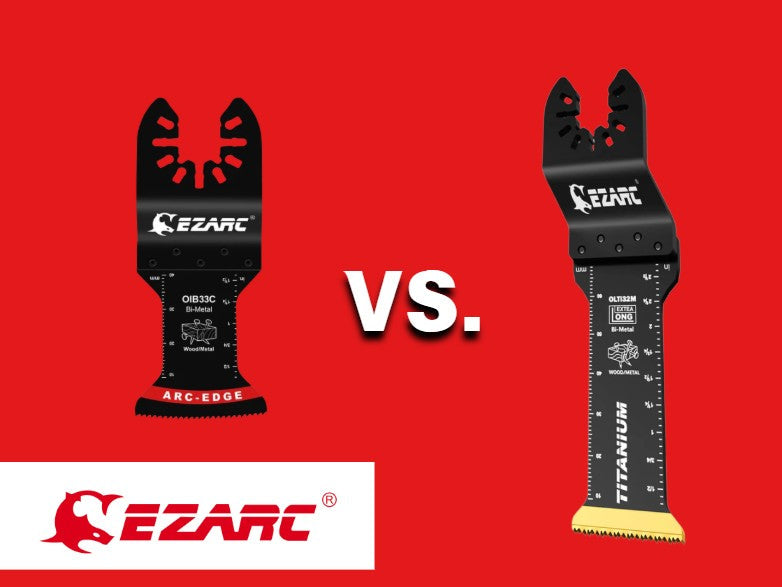
Understanding the Materials: Bi-Metal vs. Titanium

To understand performance differences for your tools, it helps to know how each blade is constructed.
- Standard Bi-Metal Blades: Constructed by electron-beam welding High-Speed Steel (HSS) teeth onto a flexible High-Carbon Steel (HCS) body. This design offers a balance of flexibility and strength, preventing the blade body from snapping under torsion while keeping the teeth hard enough to cut soft metals and wood.
- Titanium-Coated Blades: Takes the proven bi-metal foundation and coats the cutting teeth with a specialized physical vapor deposition layer—typically Titanium Nitride (TiN) or Titanium Aluminum Nitride (TiAlN). This razor-thin ceramic-like layer dramatically increases surface hardness, reduces friction, and shields the underlying HSS teeth from thermal breakdown.
Head-to-Head Comparison
| Performance Factor | Standard Bi-Metal Blade | Titanium-Coated Blade | Winner |
| Heat Resistance | Moderate (degrades above 600°F) | Exceptional (withstands 1,100°F+) | Titanium |
| Lifespan in Hardwood | Standard (1x baseline) | Up to 2x longer | Titanium |
| Nail-Embedded Wood | Easily dulled by hard nails | High resistance to tooth stripping | Titanium |
| Softwood & Drywall | Excellent | Excellent (overkill for light materials) | Tie |
| Upfront Unit Cost | Lower ($) | Moderate ($$) | Bi-Metal |
| Long-Term Cost-Per-Cut | Higher (frequent replacements) | Lower (longer service life) | Titanium |
3 Reasons Titanium Coating Makes a Massive Difference

1. Superior Heat Dissipation (The #1 Blade Killer)
The primary enemy of any cutting tool isn't hard wood or steel. It is friction heat. Tools vibrate at 20,000 oscillations per minute. Friction at the tooth tips rapidly exceeds 600°F (315°C). Standard HSS teeth then undergo thermal softening and dull rapidly.
Titanium coatings act as a thermal barrier. The layer withstands extreme temperatures up to 1,100°F (593°C) without breakdown, reflecting heat away from the steel tooth core. This heat resistance allows teeth to maintain their sharp cutting geometry even during prolonged plunge cuts.
2. Up to 2x Longer Service Life
Titanium surfaces are harder than untreated High-Speed Steel. This drastically resists abrasive wear. Titanium edges maintain their bite twice as long as uncoated bi-metal edges when cutting tough materials.
3. Lower Friction and Faster Chip Evacuation
Titanium coatings feature a lower coefficient of friction than raw steel. As the blade oscillates back and forth, the smooth surface glides through wood grain and plastic without dragging. Reduced drag leads to faster chip evacuation, less smoking or scorching of wood, and lower strain on your multi-tool’s motor.
Calculating Real ROI: Is Titanium Worth the Extra Cost?
Titanium blades may cost 20% to 30% more than basic bi-metal options. The cost per cut reveals the real value.
- Standard Bi-Metal Scenario: You buy a 5-pack of basic bi-metal blades for $15 ($3 per blade). During a room renovation involving hardwood floor trimming and nail-embedded door jambs, you burn through 4 blades due to heat softening. Total cost: $12.
- Titanium-Coated Scenario: You buy a 5-pack of titanium-enhanced blades for $20 ($4 per blade). Thanks to superior heat resistance and tooth durability, 2 blades complete the exact same job with life to spare. Total cost: $8.
Beyond raw dollar savings, using a longer-lasting blade saves valuable labor time by eliminating constant blade swaps mid-cut.
When to Use Which Blade
Use Standard Bi-Metal For:
- Softwood cutting (pine, cedar, fir).
- Drywall, plasterboard, and ceiling tiles.
- PVC, PEX, and soft plastics.
- Quick, non-repetitive DIY fixes where heat build-up is minimal.
Choose Titanium-Coated For:
- Hardwoods (oak, maple, hickory, teak).
- Nail-embedded timber and old framing lumber.
- Copper pipes, brass, aluminum profiles, and non-hardened steel screws.
- Deep plunge cuts where heat cannot easily escape.
- Heavy-duty flooring installs, flush cutting door jambs, and demolition work.
Upgrade Your Toolkit: The EZARC Titanium Advantage


You may need durability and clean cuts in tough conditions. EZARC Extended Reach Titanium Multi-Tool Blades deliver professional performance without hardware store markup.
Designed specifically for demanding applications like flush cutting door jambs and slicing through embedded nails:
- Titanium Enhanced Teeth: Engineered for maximum heat resistance and superior chip clearance, delivering up to 2x longer life compared to standard bi-metal options.
- 2-3/4" Extra Reach: Provides extended depth for effortless single-pass plunge cuts in thick door casings, wall cavities, and deep frame structures.
- High-Efficiency Cutting: Precision-set teeth speed up work progress by up to 100% faster in wood, drywall, plastic, and non-hardened metal hardware.
- Universal Fitting: Fully compatible with major multi-tool brands including Milwaukee, DeWalt, Makita, Fein, Ryobi, Porter-Cable, Craftsman, and more.
The Verdict
So, is titanium coating worth it? Unquestionably, yes.
Some projects involve more than basic drywall and softwood. Titanium blades offer heat resistance and reduced tooth wear. This makes them a smarter investment for DIYers and professionals.
What material gives your oscillating tool blades the most trouble? Share your thoughts below. Let us know if you need help choosing the right blade setup for your next job!

コメントを書く
このサイトはhCaptchaによって保護されており、hCaptchaプライバシーポリシーおよび利用規約が適用されます。