
 Connexion


The shelf-pin hole is marked, the drill is charged, the bit is seated in the chuck, and the hole still lands a couple of millimetres off centre with a halo of torn fibers around the rim. The drill did its part. The bit shape did not.
Search for broca de madera and the page fills with twist bits, spade bits, augers, Forstner bits and hole saws listed side by side, as if diameter were the only decision. Wood drilling splits into seven families because different failures kept showing up on real jobs: a point that wandered off the mark, an edge that blew out the back face, flutes that packed with chips halfway through a stud.
Geometry drives those results. A brad-point bit and a twist bit can share a shank, a flute count and a price tag, then behave completely differently once the point touches oak. Indoors, chip evacuation matters just as much: the right profile pulls dust away from the cut, and an extractor held at the drill point keeps the room workable while the hole stays clean.
Table of Contents
- Wood Drill Bit Types at a Glance
- How Each Wood Bit Works and Where It Fits
- How to Choose the Right Bit for the Job
- How Fast to Run Each Bit Size
- Keeping Dust Down When Drilling Indoors
- Choose Your Bit and Start Drilling
Wood Drill Bit Types at a Glance
Seven bit families cover almost every hole you'll drill in wood, and each solves a different problem. The table lines them up by what they're good at, the finish they leave, the sizes you'll find on a shelf, and the failure that catches people out.
| Bit type | Best for | Hole quality | Typical sizes | Watch out for |
|---|---|---|---|---|
| Twist | Pilot holes, cable routes, hidden general-purpose holes | Fair; can tear out at the exit | 1-13 mm (up to about 1/2 in) | Wanders on smooth wood without a punch mark |
| Brad-point | Dowels, joinery, furniture, any visible hole | Excellent; clean entry and exit | 3-12 mm common range | Needs a steady feed; spurs can scorch if forced |
| Spade / paddle | Fast, cheap large holes in rough softwood | Rough; exit tear-out common | 6-38 mm (1/4-1-1/2 in) | Splinters the exit side unless backed with scrap |
| Auger | Deep holes in framing timber, hand drills and braces | Good; self-clearing chips | 6-25 mm (1/4-1 in), long shanks | Screw tip pulls in fast in soft wood; control the feed |
| Forstner | Flat-bottom holes, hinge cups, overlapping holes | Excellent; smooth walls and bottom | 6-50 mm and up | Best in a drill press; heats quickly at high RPM |
| Hole saw | Door locksets, pipe pass-throughs, large bores | Fair; needs a pilot and chip clearing | 19-152 mm (3/4-6 in) | Pilot must be centred; clear chips often |
| Self-feed | Big construction bores for electricians and plumbers | Fair to good | 19-100 mm | Very aggressive; needs a high-torque drill |
Read the table by starting at the job, not at the bit you already own. If the surface will be seen, work down the Hole quality column until you hit "Excellent" and accept the cost. If nobody will ever see the hole, start at the cheapest row that reaches your diameter.
The two-line verdict: visible hole, reach for brad-point or Forstner. Deep hole, reach for auger or self-feed. Hidden and cheap, a spade or twist bit does the work and you shouldn't overthink it.
Hole saws carry more variables than the other six because tooth pitch and chip clearance decide whether the cut stays cool or burns. If your project involves door hardware or pipe penetrations, this introduction to bi-metal hole saw use covers the arbor and tooth side of the job.
You can shortlist a bit for your project from that table in about ninety seconds. The rest of this article explains why each shape behaves the way it does, what speed to run it at, and how to keep the dust out of the room.
How Each Wood Bit Works and Where It Fits
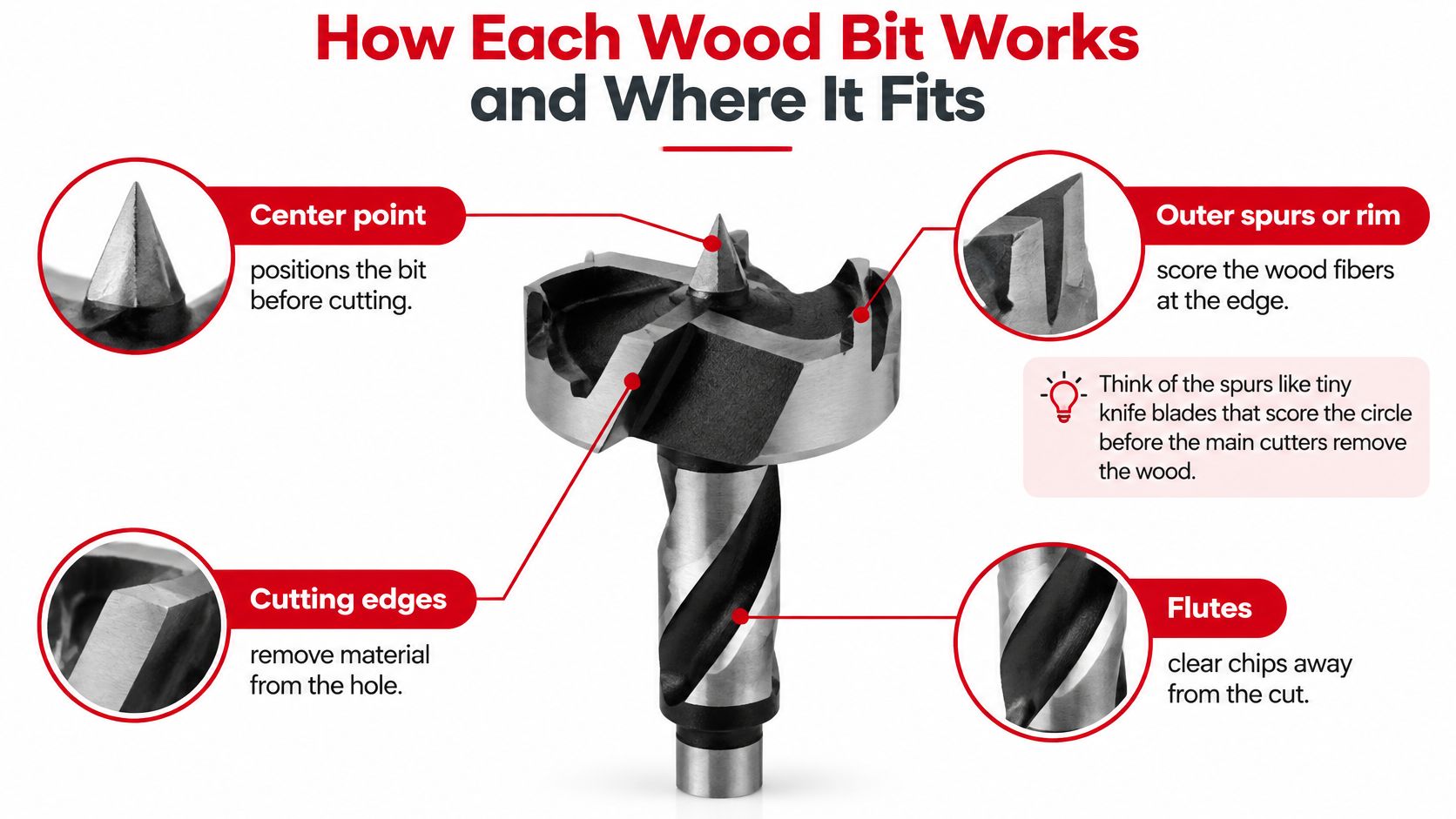
A clean hole starts with four parts working together. The center point locates the bit, the rim scores the perimeter, the main cutters remove the wood inside it, and the flutes carry chips back out. If chips remain trapped, the bit has to cut them again, creating extra heat and slowing the work.
The scoring step is easy to overlook. It works like a marking knife drawn around a circle: the rim severs surface fibers before the cutters remove the wood inside, helping leave a cleaner edge.
Here are those parts on a Forstner bit.
The history of the drill traces wood drilling back at least two millennia. The auger became a major advance because its screw-like tip pulls the bit into timber, making large or deep holes easier to bore than with bow and pump drills.
Twist Bits, the Generalist
A high-speed steel twist bit with a 118-degree point is a common choice for hidden work. Use it for pilot holes, cable routes, and clearance holes behind a cabinet. On smooth wood, it can wander from the mark, and its continuous lips may leave ragged fibers on the exit side. Place a backing board behind the work when the far face needs a cleaner finish.
Brad-Point Bits, the Joinery Standard
A brad-point bit uses a central spur to stay on the mark and two outer spurs to score the wood before the main lips cut. This helps limit wandering at entry and tear-out at exit compared with a conventional twist bit, whose lips can lift fibers unevenly, as this drill bit types guide explains.
For visible joinery, cabinetry, and furniture, choose a brad-point bit that matches the finished hole. Twist bits remain a practical choice for rough framing and concealed cable routes.
Spade Bits, Cheap and Fast
The flat paddle, also called a flat drill, makes large holes quickly in softwood, though the walls are rougher than those produced by a brad-point or Forstner bit. Clamp scrap behind the workpiece to reduce splintering at the exit. Feed steadily and withdraw the bit often so chips can escape. For more on feed technique, see this guide to using a woodworking flat drill.
Auger Bits, for Depth
An auger's screw tip draws the bit into the wood, while its deep, hollow flutes lift chips from deep holes. That makes it useful for boring through stacked studs. The screw tip can grab aggressively in softwood, so hold the drill firmly and let the flutes clear the hole rather than forcing the feed.
Forstner Bits, Flat Bottoms and Clean Walls
A Forstner bit's rim scores the full circle as its main cutters form a flat-bottomed hole with smooth walls. It suits hinge cups, overlapping bores used to remove waste, and recesses that need a flat seat. Use a drill press when possible, or keep a steady hand, and run it more slowly than a twist bit to limit heat.
The video shows the feed in motion. Notice how little pressure the cutter needs.
Hole Saws and Self-Feed Bits, the Big Bores
A hole saw combines a pilot drill with a toothed ring to make large openings for locksets and pipes. Withdraw it regularly to clear chips and reduce heat at the teeth. A self-feed bit uses a threaded point to pull its cutter through timber, making it useful for large construction bores with a high-torque right-angle drill. Its strong pull can make a smaller drill difficult to control.
How to Choose the Right Bit for the Job
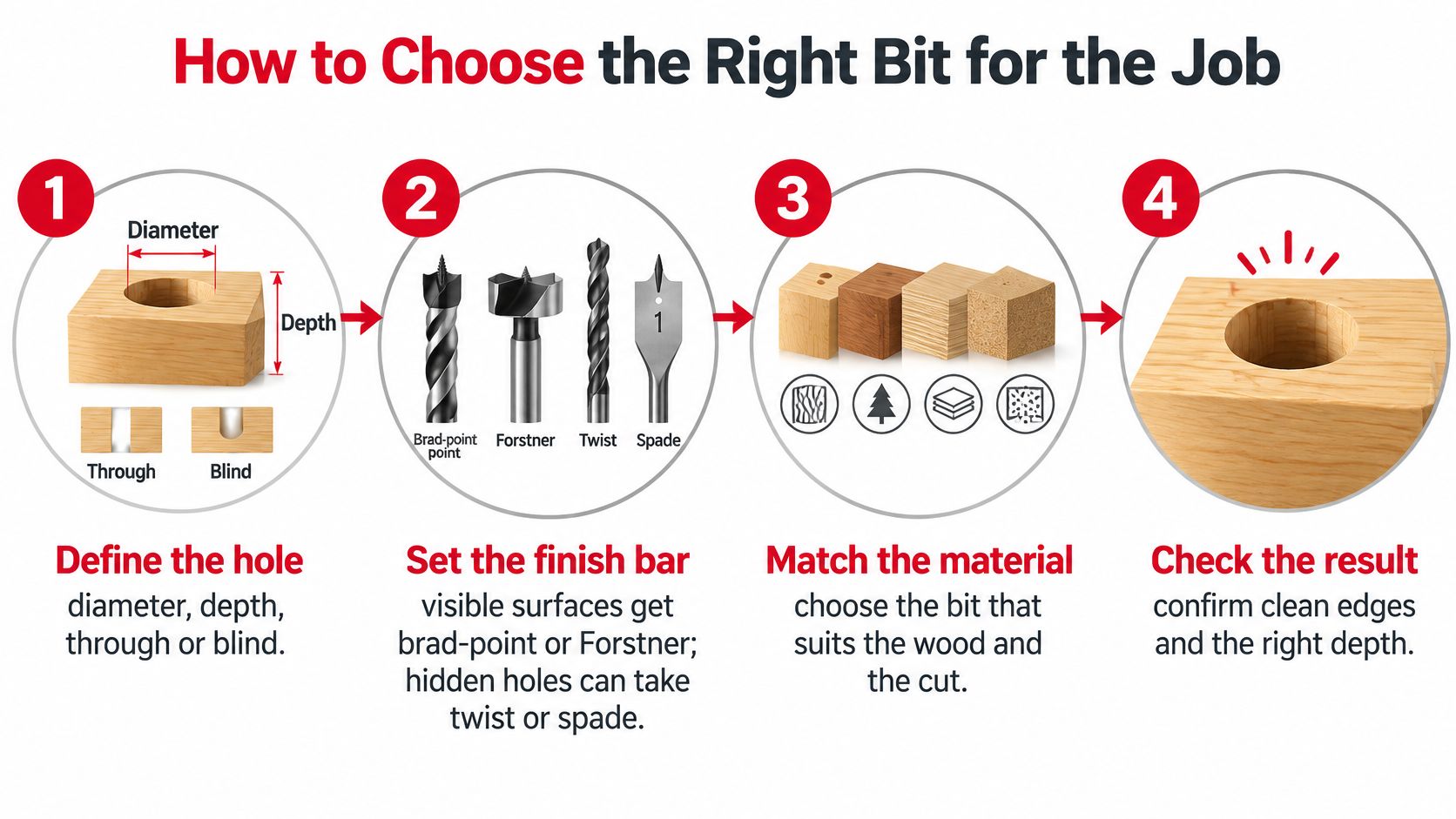
A carpenter choosing between two bits rarely compares spec sheets. The decision follows a short chain: what the hole must do, what it must look like, how deep it runs, and which machine turns it. Work through these six decisions in order and you'll land on one bit rather than a shortlist.
- Define the hole. Write down diameter, depth, and whether it goes through or stops blind. A 35 mm blind recess and a 35 mm through-hole take different bits even though they share a number.
- Set the finish bar. Anything visible on a finished surface gets a brad-point or Forstner. Hidden holes can take a twist or spade and nobody will know.
- Check the depth against the diameter. A hole deeper than about three times its own diameter is a deep hole, so the bit needs flutes or a gullet that can carry chips out instead of packing them at the bottom.
- Match the machine. Forstner bits above roughly 25 mm and large hole saws behave far better in a drill press. Hand drills suit twist, brad-point and small spades without complaint.
- Read the material. Hardwoods and knots demand sharp edges. Reclaimed timber with a chance of buried nails gets a sacrificial bit or a scan with a metal detector first.
- Verify the target size against real hardware. Measure the dowel, the hinge cup and the lockset body rather than trusting the nominal number printed on the box.
One more decision matters indoors: where the chips go. Drilling overhead in an occupied kitchen or office dumps sawdust on furniture and into the air. A bit that clears in a steady spiral lets you hold a vacuum nozzle right at the drill point and catch chips as they rise, while a bit that sprays them sideways is the harder one to keep tidy. Plan the extraction the same way you plan the bit.
Pilot holes for screws sit in the same workflow, and a countersink set with an adjustable depth stop keeps the pilot, the clearance and the head recess aligned in one pass. This guide to countersink drill bit sets walks through setting the depth collar.
| Task | Recommended bit | Why it fits |
|---|---|---|
| Dowel or peg joint, 6-12 mm | Brad-point | Anchors on the mark and leaves a clean, tight-fitting hole |
| Cabinet hinge cup, 35 mm | Forstner | Cuts a flat-bottomed, smooth-walled recess the cup seats into |
| Screw or lag pilot hole | Twist | Fast, cheap and accurate enough for hidden pilots |
| Cable or pipe pass-through in studs | Auger or self-feed | Self-clearing flutes handle deep, large bores |
| Quick hidden hole in softwood | Spade | Cheapest and fastest when finish does not matter |
| Overlapping or partial-edge holes | Forstner | Rim scores a full circle even past the workpiece edge |
When a job needs several bore diameters in one session, a kit beats buying singly. The EZARC 16Pcs Bi-Metal Hole Saw Kit Set with 3/4"-2-1/2"(19-64mm) for Wood, Metal, Plywood, PVC Board covers the 3/4" to 2-1/2" (19-64 mm) range and is made for wood, metal, plywood and PVC board, so one box handles face bores, pass-throughs and sheet goods on the same job.
How Fast to Run Each Bit Size
Speed follows one rule: the bigger the bit and the harder the wood, the lower the RPM. A wide blade travels farther on every revolution, so it produces more heat and demands more torque from the drill.
A published drill speed chart gives these starting points for wood.
| Bit diameter | Softwood RPM | Hardwood RPM |
|---|---|---|
| 1.6-4.8 mm (1/16-3/16 in) | ~3,000 | 2,500-3,000 |
| 9.9-15.9 mm (3/8-5/8 in) | ~1,500 | ~750 |
| 17.5-25.4 mm (11/16-1 in) | ~750 | ~500 |
Treat every number as a starting point, not a limit. Feed pressure, moisture content, density and how sharp the bit is all shift the actual load, which is why two people drilling the same oak board with the same bit can need different settings.
The deep-hole rule: once a hole reaches about three times the bit diameter, cut both speed and feed by roughly half. Heat, binding and chip evacuation all get worse with depth, and the 50% reduction buys you control.
Symptoms tell you which way to adjust. A burning smell, darkened chips or a bit that stalls means too much speed or too much feed, and speed is the first thing to drop. Squealing in a deep hole usually means chips are packed in the flutes, so back out, clear them and re-enter with less pressure.
Small bits are the exception to the fear of high RPM. A 3 mm brad-point bit at 2,500 RPM in pine cuts cleanly; the same bit at 600 RPM rubs, polishes and dulls.
Keeping Dust Down When Drilling Indoors
Push a spade bit into pine at full speed and the lesson arrives in seconds: a fan of chips across the bench and a fine haze hanging in the air. In an occupied house, a school or a clinic, that haze belongs in the bit decision alongside hole quality. OSHA's woodworking guidance ties wood dust to dermatitis, allergic and nonallergic respiratory effects, and cancer, and it calls for controlling dust at the source with local exhaust ventilation rather than relying mainly on personal protective equipment. The OSHA wood dust guidance cites a NIOSH recommended exposure level of 1 mg/m³ for total wood dust, far below OSHA's 15 mg/m³ nuisance-dust limit.
Bit geometry changes what leaves the hole. Flutes work like conveyor belts, and each design runs its belt differently. Auger and self-feed bits move chips aggressively, which keeps the bore clear but throws material at the surface. Brad-point bits make fine chips at shallow depth. Spade bits fed hard scatter the widest spray of debris. These are practical observations worth testing on your own scrap, not measured figures.
The workflow that works: clamp a backing board under every through-hole, park a shop vac or extractor nozzle at the drilling point before the first hole, drill at reduced speed with light feed, then clean up with a HEPA vacuum instead of a broom. A broom lifts the finest fraction back into the air, which is exactly the fraction you most want gone.
Composites are a separate problem. Ordinary wood dust and the silica dust from engineered stone, fiber-cement board and some tile backers call for different controls, and silica demands stricter protection than any wood bit choice can deliver.
Treat source capture, general ventilation and cleanup as three separate controls that all have to happen. A well-chosen bit reduces the dust the cutter makes; it never replaces extraction.
Choose Your Bit and Start Drilling
Run the first hole in a cutoff from the same board, at the diameter your hardware calls for and the RPM the speed chart gives for that size and wood type.
Do the setup once: mark the center, then use the clamp, backing and source-capture routine from the indoor dust routine above before the project piece goes under the bit.
One sharp bit in the right size beats a mixed set of cheap ones. A dull edge rubs, burns and wanders; a sharp edge tracks the mark and leaves a cleaner exit.
Read the test hole for three things: entry wander, exit tear-out and visible dust. If any one shows up, change speed, feed or backing before drilling begins, then carry the corrected settings into the project.
If the test narrows the job to a bit family and diameter, EZARC Tools sells power tool accessories and hand tools through an online store covering cutting, drilling, sanding, polishing and fastening for professional work and home projects. Product listings let you compare dimensions, tooth counts, pack quantities and arbor sizes where applicable. Browse EZARC Tools and put the right bit in the chuck the first time.