
 Log in

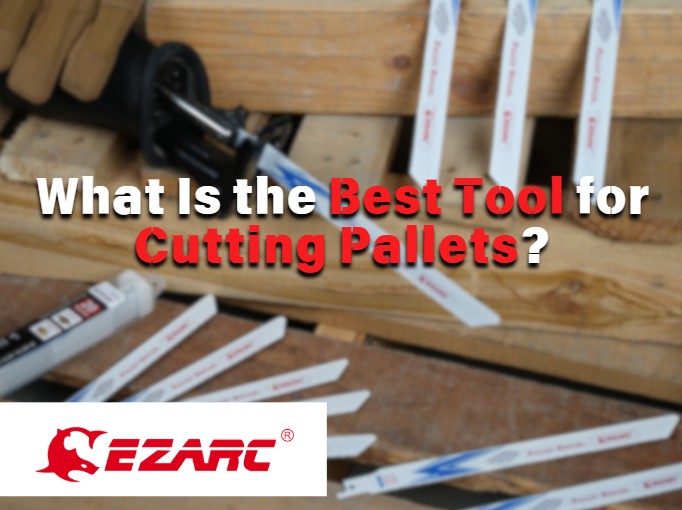
Pallets look simple. Stack of boards, couple of stringers, done. Then you actually try to take one apart and discover it's basically a wood-and-steel puzzle built by someone who really, really did not want it to come apart. Hardened spiral-shank nails, kiln-dried hardwood that fights back, and boards stacked tight enough that you can barely get a tool into the gap. Grab the wrong tool and you'll bend it, dull it, or both before the first board comes loose.
So what is the best tool for cutting pallets? Short answer: a reciprocating saw, loaded with the right reciprocating saw blades for nail-embedded wood. Long answer below, including exactly which blade set makes this job painless instead of miserable.
Why the "Obvious" Tools Fail on Pallets
A circular saw is fast on clean lumber, but pallets are not clean lumber. Hit a hidden nail at full RPM and you risk kicking the saw back at you, not to mention shredding an expensive blade in half a second. A hand saw works, technically, the same way walking works compared to driving. And a basic jigsaw just doesn't have the power or blade length to push through thick stringers and embedded fasteners without stalling or snapping. None of these tools were built around swapping in fresh reciprocating saw blades the moment one dulls, which is exactly the flexibility pallet work demands.
Pallets need a tool that can do two contradictory things at once: rip through dense, often wet or weathered wood, and chew through hardened steel nails without stopping to ask permission. That combination is exactly what reciprocating saw blades are built for, and it's why nearly every warehouse, recycling yard, and pallet-flipping side hustle eventually lands on the same setup.

Why a Reciprocating Saw Wins Every Time
A reciprocating saw's whole design advantage is the blade itself. It's long, it's replaceable in seconds, and it moves in a straight push-pull stroke that slides into tight gaps between deck boards and stringers, the exact spots where pallets are assembled and where they need to come apart. That's the whole point of a reciprocating saw blade: long, thin, and built to go places a circular saw blade never could. You're not swinging a heavy tool around. You're guiding a thin blade through a narrow seam.
That said, a reciprocating saw is only as good as whatever blade is loaded into it. Slide in a cheap wood-only blade and the first nail you hit will dull it instantly. The saw hasn't failed you. The blade has, which is exactly why pallet work calls for a purpose-built set rather than whatever's leftover in the case.
Meet the Blade Built Specifically for This: EZARC 10/14 TPI Bi-Metal Pallet Set
This is where the 10/14 TPI 9-Inch Bi-Metal Reciprocating Saw Blade Set comes in. It's a 2-piece set engineered specifically for nail-embedded wood, pallets, and pressure-treated lumber, the exact materials that chew through general-purpose blades in minutes. Out of all the reciprocating saw blades on the market, this is one of the few built from the ground up for this specific fight.
Here's what makes it work so well for pallet teardown.
Dual TPI design that handles wood and nails in one pass. The set includes a 10 TPI blade and a 14 TPI blade, both bi-metal, both 9 inches long. The 10 TPI blade is the workhorse: it rips through thick, knotty wood and embedded nails fast, the coarse teeth clearing material aggressively instead of clogging up. The 14 TPI blade is the finisher, delivering cleaner, more precise cuts on thinner boards and slats where you don't want a ragged edge. Most reciprocating saw blades make you choose one tooth count and live with it. This set hands you both, so you're never stuck reaching for the wrong reciprocating saw blade mid-job.
Bi-metal construction built to survive nails. Each blade combines high speed steel teeth with a flexible alloy back. That pairing matters because pallet nails are hardened steel, and a blade with brittle teeth or a stiff spine will chip or snap the moment it hits one. The flexible back absorbs the shock, the HSS teeth hold their edge, and the result is a blade that keeps cutting instead of giving out on the first stringer. Not many reciprocating saw blades manage to balance flexibility and hardness this well in one tool.
3x longer life in nail-penetrated material. EZARC built this set with heat-treated bi-metal alloy specifically to withstand the repeated impacts and abrasive wood fibers that wreck standard blades. Compared to a typical wood-only blade, that translates to roughly three times the service life when you're cutting through boards with nails still in them, which on a real pallet is most of them. Fewer blade changes means these reciprocating saw blades pay for themselves fast on any job with real volume.
A reverse tip designed to fight jamming. Pallet boards rarely sit flat, and gaps between boards aren't always clean or even. The reverse tip on this blade is built to enter those gaps smoothly and resist catching or jamming as the kerf closes around it, which means fewer stuck blades and fewer moments where you're wrestling the saw instead of cutting. It's a small detail, but it's one of the reasons this particular reciprocating saw blade outperform generic alternatives in tight, awkward cuts.
9-inch length for full-depth cuts. Pallet stringers and stacked boards are thicker than they look. A 9-inch blade gives you the reach to cut clean through in a single pass instead of sawing halfway and repositioning, which matters when you're doing this dozens of times in a row.
Universal fit, no adapter needed. The set uses a standard shank that drops into Milwaukee, DeWalt, Bosch, Makita, and most other major reciprocating saws without any extra hardware, so these reciprocating saw blades are ready to use the moment they're out of the package.
If you've been hunting for reciprocating saw blades that can actually survive pallet work without dulling on the first nail, this dual-TPI bi-metal set is built for exactly that job.

How to Get Clean Cuts Without Wrecking the Blade
A good blade still needs decent technique behind it. Even the best reciprocating saw blades depend on how you handle the saw to last as long as they should.
Cut at the nail, not around it. Aim the blade to slice through the nail shank where the deck board meets the stringer. This separates boards cleanly instead of splintering them.
Start with the 10 TPI blade for the heavy lifting. Save the 14 TPI blade for thinner slats or spots where you want a cleaner finish.
Keep a steady, moderate feed rate. Forcing the saw generates heat, and heat is what actually kills these blades, not the impact of hitting a nail.
Watch for binding. If the kerf closes around the blade in damp or warped wood, ease off slightly rather than forcing through.
Protect your hands and eyes. Pallet wood throws splinters, and cut nail fragments can fly. Gloves and eye protection are non-negotiable here.


Quick FAQ
What's the best tool for cutting pallets apart fast? A reciprocating saw paired with a dual-TPI bi-metal blade, something in the 10/14 TPI range, is the fastest and safest combination for nail-embedded pallet wood.
Can I use a regular wood blade on pallets? You can try, but the first hidden nail will likely dull or chip it. Pallet work calls for bi-metal reciprocating saw blades built to handle wood and steel in the same stroke.
Why does this set include two different blades? Pallet wood and pallet nails ask for opposite things from a blade. The 10 TPI blade rips fast through thick wood and nails, while the 14 TPI blade finishes thinner boards cleanly, so these two reciprocating saw blades cover you either way without swapping brands mid-job.
Will this blade set fit my existing saw? Yes. These reciprocating saw blades use a universal shank that fits Milwaukee, DeWalt, Bosch, Makita, and most other major reciprocating saw brands without an adapter.
The Bottom Line
The best tool for cutting pallets isn't the fastest-looking tool in your garage, it's the one built to handle wood and hardened nails in the same cut without quitting halfway through. A reciprocating saw gets you there, and the EZARC 10/14 TPI Bi-Metal Set is the pair of reciprocating saw blades that makes it actually work, cut after cut, board after board.
Browse the full lineup of reciprocating saw blades from EZARC to find the right match for whatever you're tearing apart next.