
 Oscillating Multi-Tool Blades
 Reciprocating Saw Blades
 Cutting & Grinding
 Hole Saw
 Drilling
 Sanding & Polishing
 Socket & Driver Set
 Hand Tools
 Metal Worker & Fabrication
 Woodworking & Carpentry
 Electrical & Plumbing
 Automotive
 Concrete & Masonry
 Demolition
 NEW ARRIVALS
Introduction
Pallet repair seems simple until you encounter issues like binding blades, hidden fasteners, or splinters. To minimize kickback, jams, and injuries, prioritize safety features when selecting your tools, then match them to the specific tasks you'll perform. Start with the right Reciprocating Saw Blades for nail-embedded wood, and build a supporting kit that helps you work with control rather than force.
This guide teaches you how to choose pallet repair tools with the right safety features to dismantle and rebuild pallets efficiently, whether you're a contractor or DIYer. Learn how to define cut tasks, select blade geometry that reduces jamming, verify shank retention, and choose finishing tools to minimize secondary hazards like splinters. You'll also see how tools like Oscillating Multi-Tool Blades, Cutting and Grinding Discs, Hole Saw Kits, Drill Bits, Sanding Abrasives, and Hand Tools fit into a safer workflow.
How to Choose pallet repair Tools Step by Step
Step 1: Define pallet repair cutting tasks
Start by writing down the exact actions you need to do on a pallet, because the safest tool is the one designed for that specific action. Typical pallet repair work usually includes prying boards loose, cutting nails between slats and stringers, making flush cuts to remove damaged sections, and trimming replacement boards to length. When you skip this step, you end up using the wrong tool for force (for example, twisting a saw blade sideways to pry), which increases binding, bent blades, and loss of control.
To make your task list actionable, break it into three columns: material (dry wood, wet wood, heat-treated hardwood, nails/staples), access (open cuts vs tight gaps), and finish requirement (rough cut is fine vs clean edge to handle safely). If more than half your work involves nail-embedded wood and mixed materials, prioritize Reciprocating Saw Blades and a solid clamping setup before you consider convenience add-ons. Also note whether you will be cutting near corners and stringers, because that is where jams and sudden tool movement are most common.
Step 2: Choose Reciprocating Saw Blades first
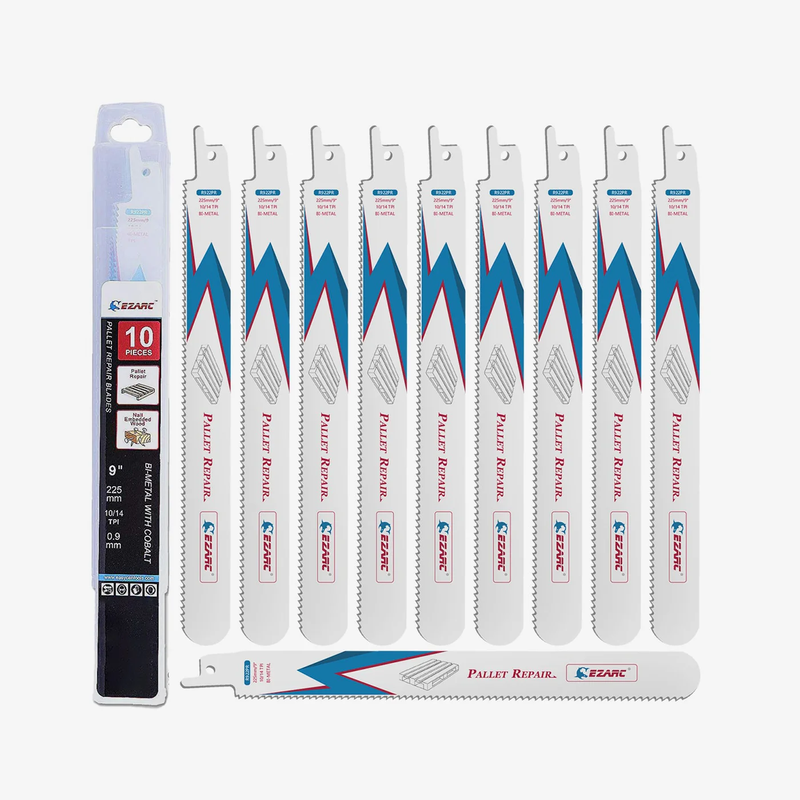
When pallet repair is the goal, Reciprocating Saw Blades should be your first decision because they do the highest-risk work: fast cutting through wood, nails, and grit-filled gaps. A practical baseline for pallet dismantling is a 9-inch blade that gives reach without feeling unwieldy, paired with a variable tooth count that can transition between wood fibers and metal fasteners without snagging. This is where many injuries happen: a blade that is too aggressive can grab on nail heads, while a blade that is too fine can overheat and wander.
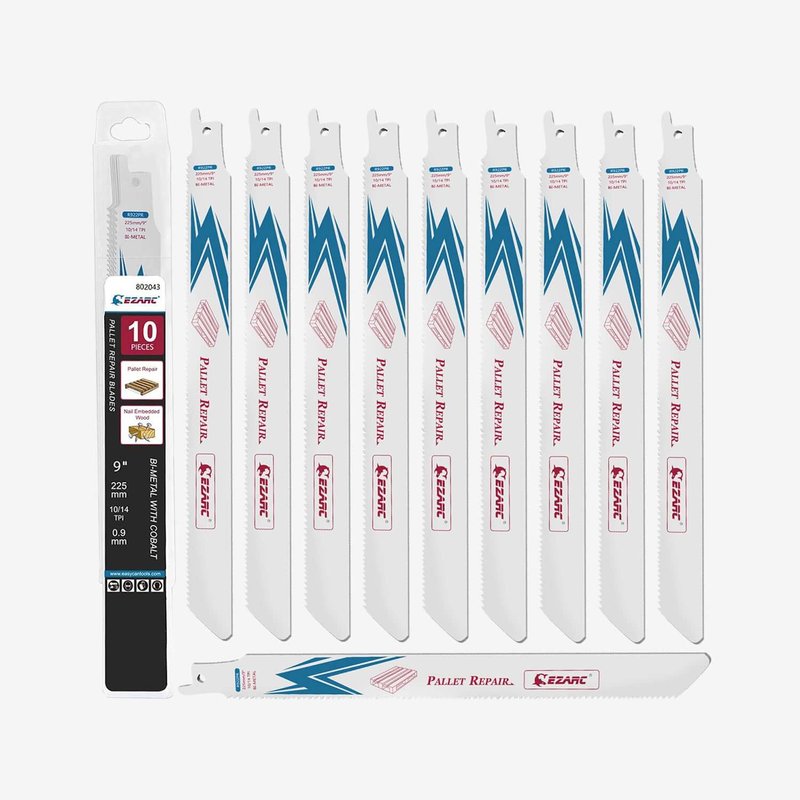
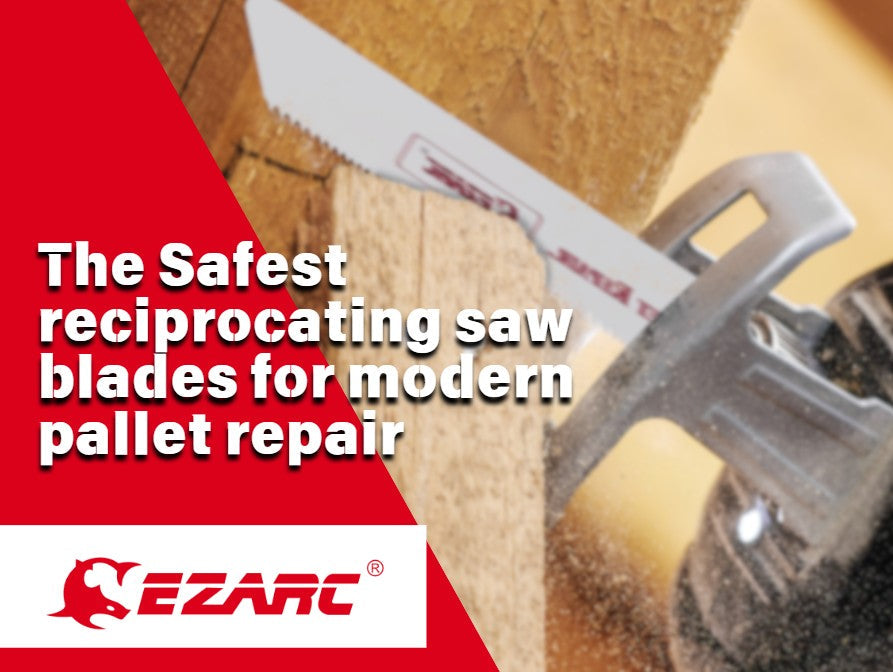
A good example of a pallet-focused choice is the EZARC Pallet Dismantling Bi-Metal 9 in 10/14 TPI Reciprocating Saw Blade (SKU 802042). The blade is listed as bi-metal with 8% cobalt, uses a 10/14 TPI vario tooth pattern, and is built for wood with nails. Key specs to compare against other blades in this category include total length 225 mm (9 in), cutting length 175 mm, and blade thickness 0.9 mm. Those details matter because thickness and tooth pattern influence how straight the blade tracks and how much it resists deflection when you hit a nail.
Step 3: Prioritize Anti-Jam Blade Features
Pallet boards often don't sit flat, making anti-jam features essential for safety. Look for blade geometry designed to enter gaps smoothly and stay stable when the kerf closes. A round tip design, like those in EZARC pallet repair blades, reduces jamming and bending, especially when cutting between slats and stringers. To reduce vibration, use a controlled feed and keep the saw’s shoe planted on the pallet. Always follow OSHA guidelines for eye and face protection, as flying fragments are a common hazard. https://www.osha.gov/laws-regs/regulations/standardnumber/1910/1910.133
Step 4: Confirm Shank Fit and Retention
Shank fit is a safety issue. A poorly seated blade can slip or eject under load. EZARC pallet dismantling blades feature a standard 1/2-inch universal shank for major saw brands. Always check blade retention by tugging on the blade, running the saw briefly at low speed, and ensuring the chuck is clean. For extra safety, disconnect the power source during blade changes to prevent accidental trigger pulls.
Step 5: Match Tooth Pattern to Material
Tooth pattern selection affects safety and cut quality. For pallets, which include softwood slats, heat-treated hardwood stringers, and metal fasteners, a variable TPI (10/14 TPI) is ideal. This allows you to cut through thick wood with the lower TPI and smooth the cut on thinner slats with the higher TPI. Avoid pushing too hard; instead, let the saw regain full speed before re-entering the material.
Step 6: Add Low-Risk Finishing Tool Categories
After cutting, use Sanding and Polishing Abrasives to smooth rough edges and reduce secondary hazards like splinters and sharp metal parts. EZARC flap sanding discs, including the T29 style, can be used to knock down edges, remove burrs, and smooth steel hardware. Choose a grit based on the job—40 grit for quick edge knockdown and 80 grit for smoother finishes. Always follow OSHA standards for eye and face protection when grinding or sanding.
Step 7: Build a Safer Supporting Tool Kit
A safer workflow requires supporting tools that reduce improvisation. Use Hand Tools like pry bars, nail pullers, or chisels for controlled leverage when separating boards. Socket and Driver Sets can help remove bolts and fasteners without dangerous cutting. Keep Drill Bits for drilling relief holes or removing fasteners, and Oscillating Multi-Tool Blades for precision flush cuts in tight spaces. Reserve Cutting and Grinding Discs for metal-only tasks, avoiding their use in mixed wood-and-nail cuts where kickback risk is higher.
Scenario Variations
- For Heat-Treated Pallets Heat-treated wood is harder and more brittle, which can wear down blades faster and cause more splintering. Use Reciprocating Saw Blades designed for wood with nails and keep a spare pack on hand. Slow your feed rate to avoid chattering. After cutting, use Sanding and Polishing Abrasives to smooth sharp edges before handling.
- For Tight Gaps Between Slats and Stringers When working in tight spaces, prioritize control over reach. A 9-inch blade can work, but focus on anti-jam tip geometry and keep the saw shoe firmly planted to reduce vibration. If the gap is too tight to anchor the shoe, switch to Oscillating Multi-Tool Blades for short, controlled cuts.
- For Flush Cuts on Repairs When making flush cuts (e.g., removing a broken slat end), choose a blade that is flexible enough to ride along the surface while resisting shank damage. Keep the shank fully seated, avoid side loading, and consider doing a short starter cut to establish a track before committing to the full stroke.
- For High-Volume Pallet Repair Standardize your workflow to avoid improvisation. Keep spare blades ready for quick swaps, set up a stable cutting station with clamps, and designate separate areas for cutting, disassembly, and finishing. This improves control, reduces congestion, and minimizes accidental contact with moving tools.
Safety Issues
Safety Considerations
Wear safety glasses with side protection at a minimum, and consider a face shield for high-debris steps like nail cutting and grinding. OSHA guidance emphasizes that eye and face protection should be used when hazards include flying fragments and particles, which is common in pallet cutting and sanding. Keep cut-resistant gloves on for handling pallets, but avoid loose cuffs that can catch on moving parts. Stabilize the pallet so it cannot rock, and never cut with the pallet balanced on an unstable stack.
Before changing blades, disconnect power (unplug or remove the battery) and let the tool come to a complete stop. Inspect pallets for hidden fasteners, staples, or embedded metal strapping before you cut, because unexpected metal contact increases spark and kickback risk. In December 2025, ANSI/ISEA announced the publication of an updated Z87.1-2025 standard for occupational eye and face protection, reinforcing the importance of selecting protection matched to impact hazards and work conditions.
Troubleshooting
| Problem | Cause | Solution |
|---|---|---|
| Blade jams mid-cut | Cutting at an angle, kerf closing, or debris in the gap | Stop, back out slightly, re-anchor the saw shoe, and restart with lighter pressure. Create a small pry gap with Hand Tools to keep the kerf open. |
| Excess kickback or grabbing on nails | Dull teeth, too aggressive feed, or hitting a fastener at the tip | Swap to a fresh Reciprocating Saw Blade, reduce feed pressure, and approach nails with the shoe planted so the blade enters square. |
| Bent blade | Side loading while prying or forcing the blade through tight gaps | Do not pry with the blade. Use a pry bar to open space, then cut. Choose blades with reinforced shank features for pallet work. |
| Cut wanders off the line | Blade flex from long reach, uneven pressure, or mixed-material transition | Slow down, let the blade work, and check that the shoe stays in contact. For long cuts, mark both sides of the board and re-align every 6-8 inches. |
| Excess splintering on slats | Wrong tooth selection for thin wood or rushing the cut | Use the higher TPI portion of a vario tooth blade for thinner slats, and finish edges with light sanding to remove splinters. |
Conclusion
Choosing pallet repair tools with the right safety features is mostly about preventing the predictable failures: jams, kickback, and unsafe improvisation. Start by defining your tasks, then choose Reciprocating Saw Blades built for nail-embedded wood with anti-jam tip geometry, a secure universal shank, and a mixed-material tooth pattern. After that, add Sanding and Polishing Abrasives and the right supporting Hand Tools so finishing and disassembly stay controlled. Once you standardize these choices, pallet repair becomes faster, more consistent, and safer for everyone handling the finished pallets.
FAQ
What safety features matter most for pallet repair?
Anti-jam tip geometry and strong shank retention matter first because they directly reduce binding and sudden tool movement. Look for blades designed for wood with nails, since they are built to handle mixed materials without snagging. Also prioritize a setup that lets you keep the saw shoe planted and the pallet clamped, because stability often prevents accidents more than raw cutting power. Finally, include a finishing step to remove splinters and sharp edges so handling the repaired pallet is safer.
Do I need other tool categories besides saw blades?
Yes, because safe pallet repair is not only cutting. Hand Tools help you create controlled gaps and remove boards without twisting a blade or using the saw as a pry bar. Sanding and Polishing Abrasives help remove splinters and burrs that cause hand injuries during stacking and transport. A Socket and Driver Set can eliminate risky cutting by letting you remove bolts or brackets the right way. If you encounter specialty tasks, Drill Bits and Sets, Oscillating Multi-Tool Blades, and Cutting and Grinding Discs can fill in safely when used for the right materials.
How often should I replace reciprocating saw blades?
Replace a blade when cutting noticeably slows, the tool starts to vibrate more than usual, or you see wandering and grabbing at nail transitions. Heat is another sign: if the blade discolors or the cut smells like burning wood quickly, the teeth are likely dull or clogged. For safety, also replace blades that show any bending, cracks near the shank, or missing teeth. Keeping a spare pack on hand is often safer than trying to finish a job with a worn blade.
Table of Contents
- Introduction
-
How to Choose pallet repair Tools Step by Step
- Step 1: Define pallet repair cutting tasks
- Step 2: Choose Reciprocating Saw Blades first
- Step 3: Prioritize Anti-Jam Blade Features
- Step 4: Confirm Shank Fit and Retention
- Step 5: Match Tooth Pattern to Material
- Step 6: Add Low-Risk Finishing Tool Categories
- Step 7: Build a Safer Supporting Tool Kit
- Scenario Variations
- Safety Issues
- Troubleshooting
- Conclusion
- FAQ

コメントを書く
このサイトはhCaptchaによって保護されており、hCaptchaプライバシーポリシーおよび利用規約が適用されます。