
 Cuchillas Oscilantes Multiherramienta
 Hojas de sierra recíproca
 Corte y Esmerilado
 Sierra de corona
 Perforación
 Lijado y pulido
 Juego de vasos y llaves de vaso
 Herramientas Manuales
 Trabajador de metal y fabricación
 Carpintería
 Electricidad y fontanería
 Automotriz
 Hormigón y Albañilería
 Demolición
 NUEVAS LLEGADAS
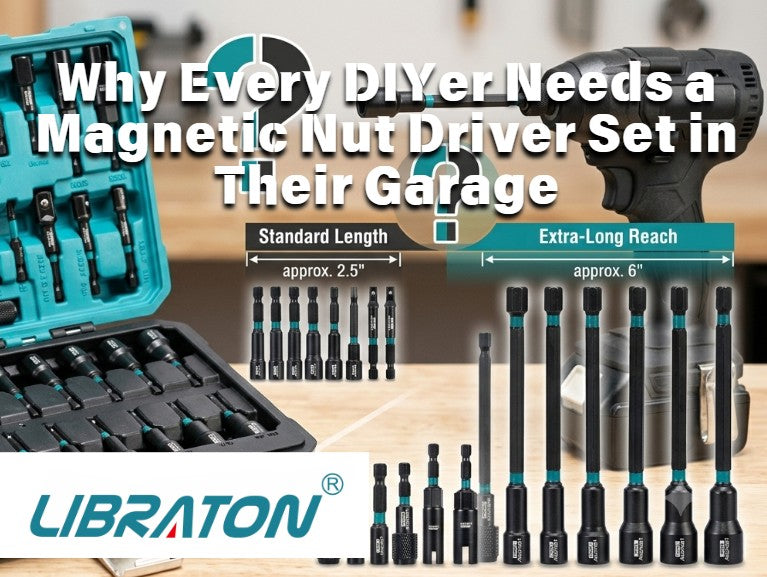
When outfitting your garage or workshop with power tool accessories, choosing the right fasteners and bits can drastically impact your productivity. If you regularly work with hex nuts, lag screws, or sheet metal fasteners, adding a high-quality nut driver set to your drill or impact driver is essential.
However, once you start browsing through options, you will quickly encounter a key design distinction: shank length. Some kits feature compact two-and-a-half-inch bits, while others focus on extended six-inch shafts.
Should you opt for traditional standard lengths, or do you need extended reach in your nut driver set? This guide breaks down the practical differences, pros and cons, and real-world applications of each style so you can make the smartest choice for your toolbox.
The Core Difference: Shank Length Explained
At a basic level, all nut drivers perform the same core function: they lock onto hex-head fasteners to allow rapid driving and removal using a power tool or manual handle. The crucial factor that separates standard models from extended versions in a nut driver set is the distance between the quarter-inch hex shank and the socket head.
- Standard Drivers (2.5 Inches): Engineered for maximum torque transfer, compact clearance, and everyday fastening in open spaces.
- Extra-Long Drivers (6 Inches): Designed specifically to reach deeply recessed hardware, bypass surrounding obstacles, and eliminate chuck collisions.
While both styles serve important roles, choosing the right set for you with only one length often forces you to compromise on either accessibility or compact convenience.
When to Use Standard Length Drivers
Standard bits measuring roughly two to three inches are the traditional workhorses of the tool world. They are compact, lightweight, and easy to control.
Key Advantages:
- Higher Torque Stability: Shorter steel shanks experience less torsional flex under heavy loads, making them ideal for breaking loose stubborn or rusted bolts.
- Compact Maneuverability: Short bits allow you to work comfortably inside tight cabinets, small junction boxes, and shallow enclosures where space is limited.
- Easier Tool Control: Because the driver socket sits close to your power tool chuck, there is minimal wobbling, allowing for straight and precise fastener placement.
Best Applications:
Standard lengths in your nut driver set are perfect for flat surface driving, benchtop woodworking, small furniture assembly, and open electrical work where obstructions are minimal.

When Extra-Long Drivers Are Essential
While standard bits handle routine tasks well, they quickly fail when hardware is buried behind pipes, engine components, or deep metal framing. Trying to force a short bit into a deep space often leads to the chuck of your drill rubbing against surrounding surfaces, scuffing materials or stopping the tool entirely.
This is precisely where extended bits in a the set become indispensable.
Key Advantages:
- Bypassing Obstacles: The extended six-inch shaft acts as a built-in extension, allowing you to reach past hoses, wiring looms, and structural brackets effortlessly.
- Deep Recess Access: Hardware located inside deep HVAC cabinets, appliance housings, or automotive engine wells becomes easy to service without disassembling surrounding panels.
- Improved Sightlines: The extra distance keeps your bulky power driver away from the fastener, giving you a clear view of the working area in tight or dimly lit spaces.
Best Applications:
Extended bits shine in automotive engine bays, HVAC ductwork installations, plumbing strap adjustments behind sinks, overhead garage track maintenance, and heavy machinery repair.
Comparison Summary: Standard vs. Extra-Long
| Feature | Standard Length (2.5 Inches) | Extra-Long Length (6 Inches) |
| Best For | Open spaces, high torque | Recessed bolts, deep clearance |
| Flex Resistance | Maximum stability | Moderate (requires quality steel) |
| Visibility | Moderate | Excellent line-of-sight |
| Portability | Ultra-compact | Requires deeper storage |
| Chuck Clearance | Low clearance | High clearance |
Why You Shouldn't Have to Choose Just One
For serious DIYers, trade professionals, and home mechanics, relying solely on one shank length eventually causes unnecessary delays. A short bit will not reach a recessed valve cover bolt, while an extended bit can be awkward to handle inside a cramped cabinet.
Instead of buying separate kits or constantly relying on loose wobble adapters, the ideal approach is investing in a master set that includes both standard and extra-long options in a single organized case.
Product Spotlight: Libraton 54-Piece Impact Nut Driver Set
If you want complete flexibility for any project, the Libraton 54-Piece Impact Nut Driver Set delivers the ultimate dual-length solution.
Forged from premium Chrome Vanadium steel with a corrosion-resistant black phosphate finish, this comprehensive set includes both short two-and-a-half-inch bits and six-inch extra-long bits across full Metric and SAE size ranges.
Highlights of the 54-Piece Master Kit:
- Dual Length Coverage: Includes standard 2.5-inch and extended 6-inch shanks, ensuring you always have the right reach for the job.
- Complete Sizing: Features 15 Metric sizes (5mm to 15mm) and 15 SAE sizes (3/16" to 9/16") to handle imported and domestic hardware alike.
- Powerful Neodymium Magnets: Deep magnetic sockets lock nuts and lag screws firmly in place for easy one-handed driving.
- Impact Ready: Quarter-inch quick-change shanks absorb high torque from modern impact drivers without splitting or stripping.
- Bonus Accessories: Equips your shop with quick-release bit holders, socket adapters, and specialized wing nut drivers for maximum versatility.
- Heavy-Duty Storage: Comes packed in a blow-molded carrying case with clear size markings for fast organization.
Equipping your workspace with a dual-length set ensures you never have to pause a project due to clearance issues again.


Final Thoughts
Deciding between standard and extended shank lengths comes down to the specific demands of your projects. Standard bits offer maximum torque and compact control for everyday driving, while extended options provide the reach required for complex automotive, HVAC, and machinery repairs.
By selecting a versatile nut driver set that provides both options in SAE and Metric sizing, you get the best of both worlds, saving time and keeping your workflow seamless.

Dejar un comentario
Este sitio está protegido por hCaptcha y se aplican la Política de privacidad de hCaptcha y los Términos del servicio.