
 Oscillating Multi-Tool Blades
 Reciprocating Saw Blades
 Cutting & Grinding
 Hole Saw
 Drilling
 Sanding & Polishing
 Socket & Driver Set
 Hand Tools
 Metal Worker & Fabrication
 Woodworking & Carpentry
 Electrical & Plumbing
 Automotive
 Concrete & Masonry
 Demolition
 NEW ARRIVALS
Introduction
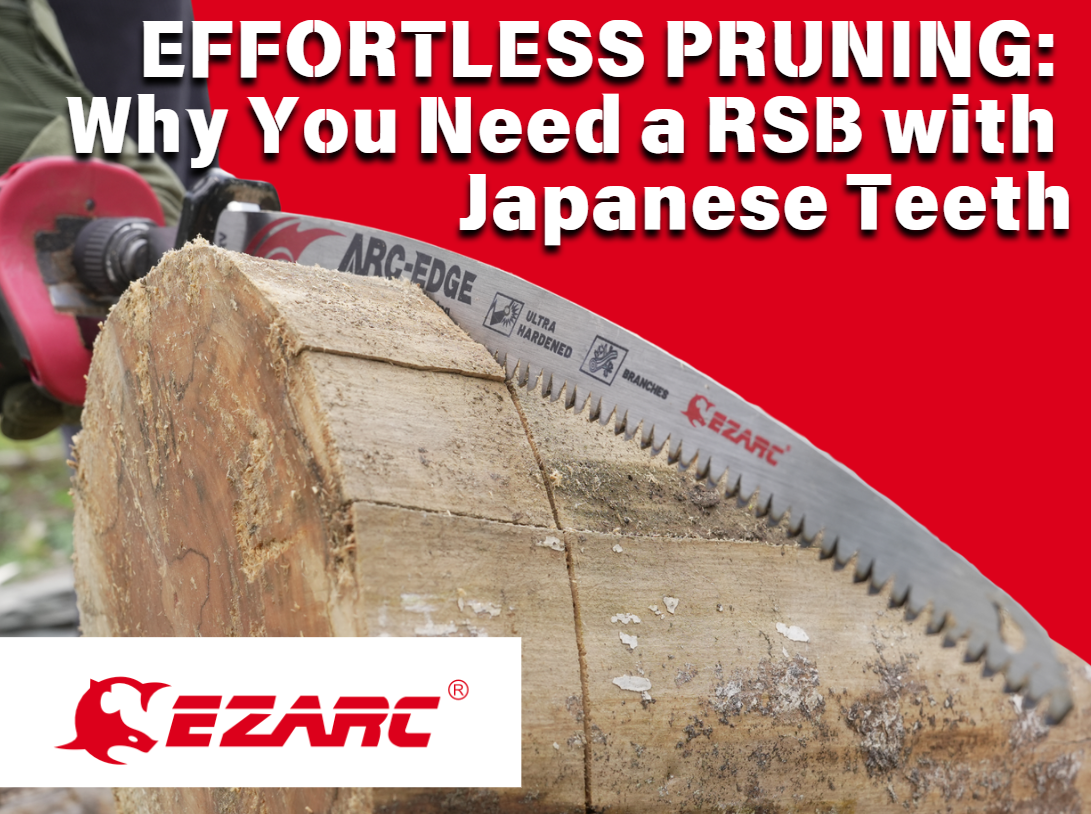
When pruning thick, green, or wet wood, standard straight reciprocating saw blades often bind, overheat, and drain batteries quickly. Curved pruning blades are designed to address these issues—their shape helps pull the blade into the material with each stroke, allowing for faster, smoother, and more controlled cuts.
Key factors in blade performance include the curved geometry, which reduces binding; tooth design and spacing (TPI), which affect chip removal; and the use of hardened steel such as Cr-V for long-lasting sharpness. For cutting green or damp wood efficiently, a specialized curved blade—like those featuring Japanese-style tooth patterns—delivers better speed, less binding, and greater durability compared to general-purpose straight blades.
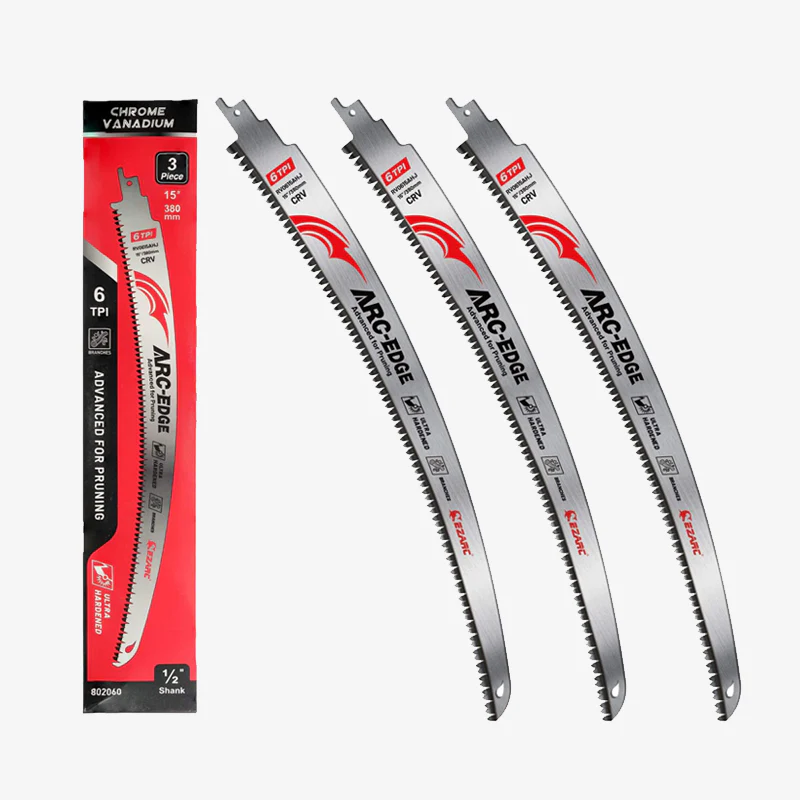
Table of Contents
- Introduction
- Curved Sawzall Blade FundamentalsBlade geometry: curve radius and leverageTooth science: TPI, gullet, and grindMaterials: Cr-V steel and heat treatmentFitment: universal shank compatibility
- Curved Profile Cutting Mechanics
- Tooth Design That Extends Life
- Material and Heat Treatment Durability
- Anti-Binding and Vibration Control
- Matching Blade to Job ScenarioPruning: green wood and storm cleanupFirewood: dense timber and fast rip cutsYard work: overhead reach and controlCurve aggressiveness: control vs. speed balanceSteel and coating: wet use and rust riskDecision table: scenario-first selection
- Best Practices and Common MistakesBest practicesCommon pitfalls to avoid
- Frequently Asked QuestionsDo curved blades cut faster than straight?What TPI is best for pruning branches?Why does my blade bind in wet wood?Will a pruning blade fit my reciprocating saw?What’s the difference between Japanese-style teeth and standard wood teeth?When should I use carbide teeth instead of steel teeth for pruning?Can I combine pruning technique best practices with other tool categories?
- Conclusion
Curved Sawzall Blade Fundamentals
Blade geometry: curve radius and leverage
A curved Sawzall blade changes how force transfers from the tool into the wood. With a straight profile, you often get a “two-point” contact pattern: the tooth line bites, then the blade body drags, and the cut alternates between grabbing and slipping—especially when the branch flexes. A curved profile encourages continuous engagement by guiding the tooth line into the material as the saw cycles. Practically, that means less need to push hard, fewer stalls, and less wandering when you’re cutting at awkward angles.
The curve also improves leverage in pruning because branches rarely sit perfectly square to your stance. When you’re reaching into a canopy or cutting close to a branch collar, you’re managing tool weight, recoil, and stability. A curved profile can feel more “self-centering,” helping the blade track through the kerf without forcing you to twist the saw—one of the fastest ways to overheat and dull teeth.
Tooth science: TPI, gullet, and grind
Tooth design is the main reason one pruning blade lasts weeks while another lasts one afternoon. Three elements matter most:
- TPI (teeth per inch): Lower TPI generally cuts faster in green wood because each tooth takes a larger chip. It’s also more tolerant of dirty bark and fibrous grain.
- Gullets (chip pockets): Deep gullets store and move chips out of the kerf. If gullets are shallow, chips pack in wet wood, friction spikes, and binding follows.
- Grind geometry: Fleam-style grinds (angled cutting edges) reduce cutting resistance by slicing fibers rather than scraping them.
On EZARC’s curved pruning blade, the design emphasizes aggressive cutting in green/wet wood with Japanese-style teeth and deep gullets, and it explicitly highlights fleam-ground tooth geometry aimed at faster chip clearing and lower heat buildup.
Materials: Cr-V steel and heat treatment
Even the best tooth pattern fails if the steel can’t hold geometry under heat and vibration. Chrome-vanadium (Cr-V) steels are commonly chosen for their balance of toughness and strength. In pruning, toughness matters because the blade experiences shock loads: knots, bark inclusions, sudden pinch from branch movement, and intermittent contact when cutting overhead. A tougher blade body resists bending and micro-cracking, which helps keep teeth aligned and reduces the chance of wobble-induced rounding.
Heat treatment is the multiplier. A properly treated blade can keep teeth sharper longer by resisting plastic deformation at the cutting edge. In real use, “dulling” is often teeth rolling over rather than chipping off—especially when users push too hard or let chips pack. The goal is to keep the edge stable while still maintaining enough toughness that teeth don’t become brittle.
Fitment: universal shank compatibility
Fitment is simple but essential: if the blade doesn’t lock in cleanly, performance and safety suffer. Most modern reciprocating saws use a universal shank interface, but there are still differences in clamp wear, insertion depth, and how securely the blade seats under vibration. Always confirm full engagement in the chuck and test with a gentle trigger pull before entering a cut. For pruning specifically, ensure the blade length provides enough reach so the shoe can brace against the branch—bracing is one of the easiest ways to reduce chatter and extend tooth life.
Curved Profile Cutting Mechanics
A curved Sawzall blade performs better primarily because it improves how teeth stay engaged through the stroke. In thick limbs, straight blades often transition between “biting” and “skating,” especially when the operator can’t keep constant pressure due to awkward reach. The curve helps maintain a consistent tooth attack angle, so each stroke continues to remove material rather than re-polishing the same fibers. That consistency is what most users interpret as “cuts faster,” and it also reduces the temptation to force the saw—one of the main causes of heat and premature dulling.
The curve also reduces stall and chatter in real pruning conditions. Branches move. They flex, pinch, and sometimes close the kerf as the cut finishes. Because a curved profile tends to keep contact distributed and encourages chips to exit, it’s less likely to jam abruptly. That means fewer mid-cut recoveries, less battery drain on cordless tools, and better control when making finish cuts near sensitive areas (like avoiding bark tearing).
When you pair curved geometry with an aggressive tooth system, you get the full benefit. EZARC’s Tree Trimming/Wood Cutting – Japanese Teeth 6 TPI Reciprocating Saw Blade emphasizes an innovative arc edge design plus aggressive Japanese-style teeth aimed at ultra-fast coarse cutting and better leverage in tight or overhead positions.
Tooth Design That Extends Life
A curved Sawzall blade lasts longer when its teeth do two things well: cut efficiently (low resistance) and manage waste (chips) before heat and friction build. For pruning, the “enemy” is usually wet, stringy fiber mixed with bark. That material doesn’t behave like kiln-dried lumber; it compresses, it clogs, and it creates friction quickly. Tooth design that’s optimized for green wood focuses on aggressive bite, fast chip evacuation, and reduced rubbing.
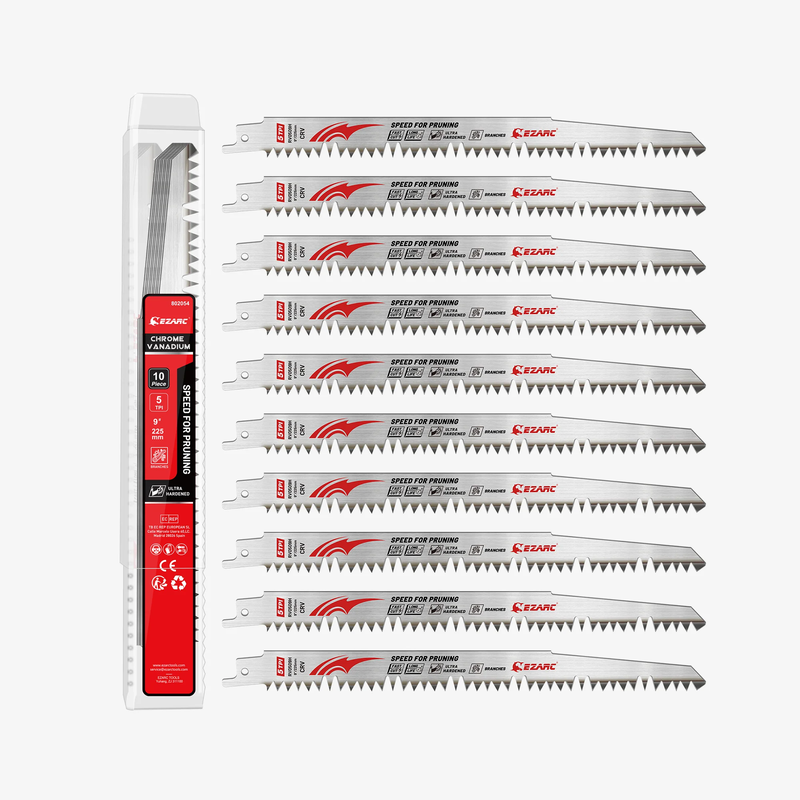
Low TPI for aggressive green wood: Lower TPI blades (like 5–6 TPI) generally remove larger chips and clear the kerf faster in wet wood. This reduces time in the cut and reduces friction-driven temperature rise. If you use too high a TPI in green wood, each tooth takes a small bite, chips turn into pulp, and gullets fill—binding becomes much more likely.
Fleam grind reduces cutting resistance: Fleam-ground teeth slice fibers at an angle instead of scraping straight across. In practice, this can make the blade feel smoother and reduce the “grab-release” sensation that leads users to push harder. Less pushing usually means less heat, and less heat means longer edge life.
Deep gullets reduce heat by clearing chips: Deep gullets are not just for speed—they are an anti-overheating feature. Packed chips cause sidewall friction, which can polish and round tooth edges quickly.
For faster pruning cuts with a tooth system purpose-built for wood and wet wood, EZARC offers pruning-specific designs such as Pruning – Fleam Ground Teeth, 9/12 in, 5 TPI Reciprocating Saw Blade, which targets fast cutting with a tooth grind meant to reduce resistance and keep chips moving.
Material and Heat Treatment Durability
A curved Sawzall blade can have the right geometry and still die early if the body steel and tooth stability can’t handle real pruning forces. Durability is not only “wear resistance”—it’s also about staying straight, resisting vibration fatigue, and maintaining tooth alignment when the cut pinches.
Cr-V steel for toughness and wear: EZARC highlights heavy-duty Cr-V polished steel on its curved pruning blade, positioning it as a durability-focused material choice for yard work and wet wood use. Toughness matters because pruning cuts are rarely “clean laboratory cuts.” You run into knots, bark inclusions, and sometimes dirt contamination near the base of limbs.
Hardened teeth resist rounding: In field use, many “dull” blades aren’t missing teeth—they have edges that have rolled over due to heat and pressure. Heat treatment and edge geometry determine how quickly that rounding happens. The more your blade can keep sharp corners at the cutting edge, the less you need to force the cut, and the less heat you create.
Corrosion resistance for wet wood: Wet wood and sap don’t just slow you down; they can increase friction and promote surface corrosion over time. While corrosion doesn’t instantly dull teeth, it can roughen the cutting path, increase drag, and make cleaning harder. A blade that holds up in damp storage conditions (truck bed, garage, tool bag) is more likely to perform consistently across a season.
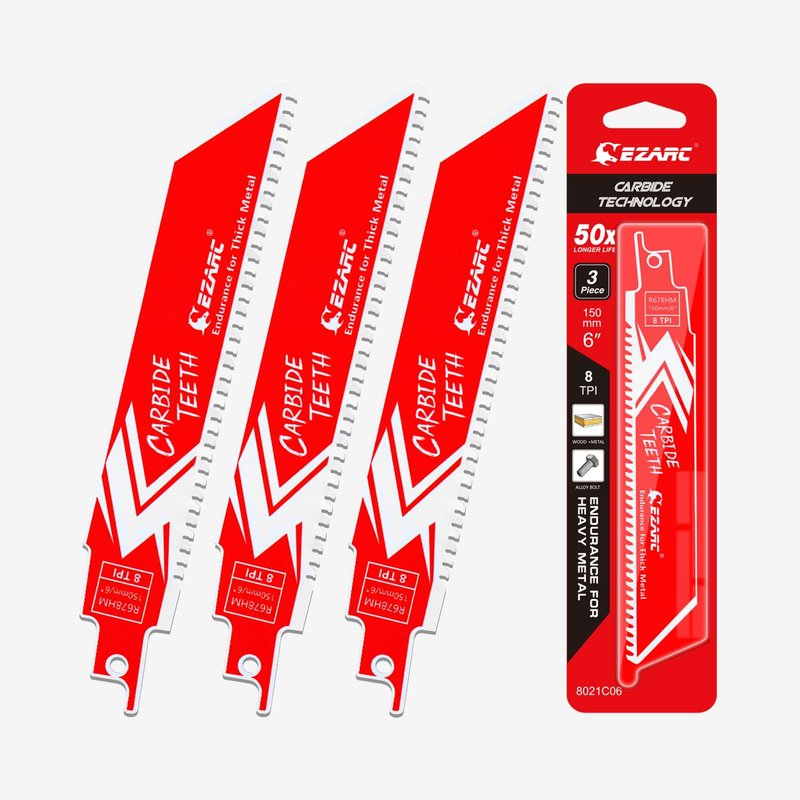
If your “job scenario” includes dense timber or hard wood where abrasion is higher and tooth loads are heavier, carbide-tooth designs are often preferred. EZARC’s pruning lineup includes a Hard Wood Cutting – Carbide, 9/12 in, 3 TPI Reciprocating Saw Blade, designed for tough wood-cutting demands where edge retention is critical.
Anti-Binding and Vibration Control
Binding is the #1 reason users believe a blade is “bad,” when the real issue is usually a mismatch between blade design, technique, and wood conditions. A curved Sawzall blade can reduce binding, but only when the rest of the design supports kerf clearance and stable tracking.
Offset teeth for sidewall clearance: When teeth are offset, they widen the kerf slightly so the blade body doesn’t rub as much. Less rubbing means less heat, less friction, and fewer stalls. EZARC specifically describes its curved arc-edge pruning blade as having triple-ground offset teeth that provide multiple cutting angles while reducing friction and vibration.
Better kerf clearance during plunge cuts: Plunge cuts into branches (especially when you can’t start from the end) are where many blades jam. The key is to create a kerf that stays open long enough for chips to clear. Curved profiles can help keep the cutting front active, while offset teeth and deep gullets help keep the kerf from packing.
Lower vibration protects tooth edges: Vibration is not just uncomfortable—it’s destructive. It creates micro-impacts at the cutting edge that accelerate rounding. It also encourages users to “muscle” the saw, further increasing heat. Anything that reduces vibration (proper bracing with the shoe, correct blade length, and tooth geometry that cuts instead of chatters) will extend life.
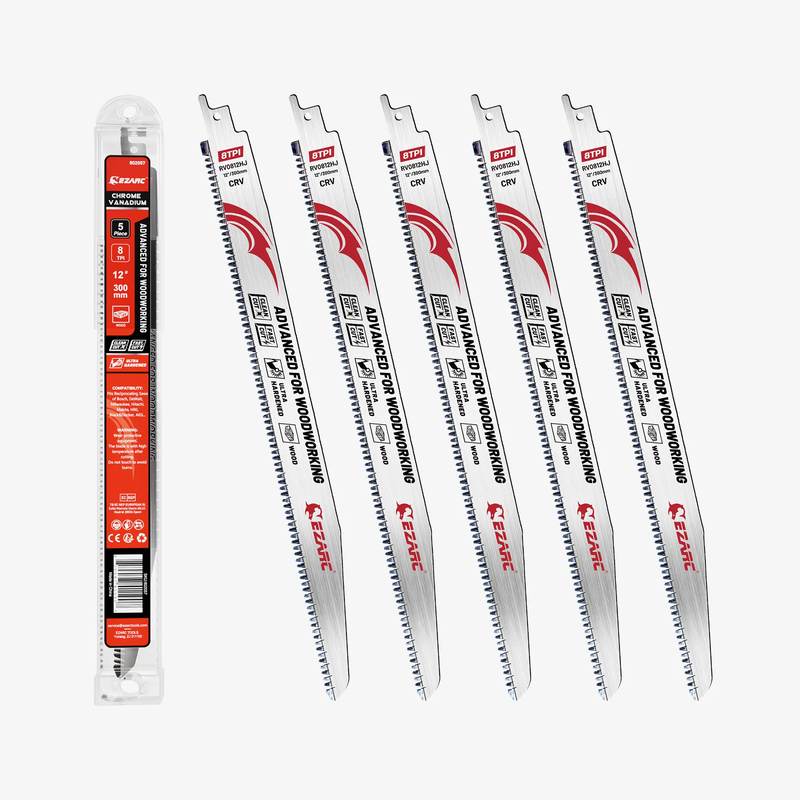
For users who want the curved arc-edge benefit but prefer a slightly finer tooth count for cleaner control in certain wood types, EZARC also offers an arc-edge Japanese tooth option in 8 TPI.
Matching Blade to Job Scenario
A curved Sawzall blade lasts longer when it’s chosen for the actual work—wood type, moisture content, limb diameter, and access constraints. Below are the most common pruning scenarios and how to think about blade selection so you’re not fighting the cut.
Pruning: green wood and storm cleanup
Green wood is fibrous and wet; storm wood is often twisted under tension and may pinch unexpectedly. Prioritize aggressive cutting and chip evacuation: lower TPI, deeper gullets, and geometry that keeps engagement stable. In this scenario, a curved arc-edge blade can improve control when you’re reaching into awkward positions. Also, consider safety: if branches are near power lines, maintain minimum approach distances; OSHA treats work within 10 feet of energized lines as a special category requiring appropriate training and practices. (https://www.osha.gov/etools/electric-power/overhead-line-work/line-clearance-tree-trimming-operations)
Firewood: dense timber and fast rip cuts
Firewood cuts are repetitive and often done at less awkward angles, but wood density is higher and the goal is speed. Lower TPI still helps, but tooth material and edge retention become more important when you’re cutting continuously. If you commonly cut dense hardwood, carbide-tooth blades are often the durability choice. Bracing the shoe and letting the saw do the work will reduce heat and make edges last.
Yard work: overhead reach and control
Overhead pruning is where blade stability matters most. Longer blades give reach, but they also amplify vibration if you don’t brace. A curved profile can reduce “walking” at the start of the cut, and offset-tooth systems can reduce friction when you’re cutting at odd angles. Choose a blade length that allows you to keep the shoe planted against the limb whenever possible.
Curve aggressiveness: control vs. speed balance
More aggressive curvature can keep engagement consistent and help the blade track through the cut, especially on larger limbs. However, if you mainly prune smaller branches, an overly aggressive curve can feel “grabby.” The best choice is the one that lets you cut with light pressure and stable tracking—because light pressure is what keeps heat down and teeth sharp.
Steel and coating: wet use and rust risk
If you store blades in a damp environment or routinely cut wet wood, prioritize steels and finishes that resist corrosion and maintain smooth cutting surfaces. A blade that stays clean and doesn’t develop rough surface oxidation will generally run cooler and bind less over time.
Decision table: scenario-first selection
| Application scenario | Material condition | What matters most | Practical blade direction |
| Seasonal pruning | Green wood, sap, bark | Chip evacuation + control | Curved profile + low-to-mid TPI + deep gullets |
| Storm cleanup | Wet wood, tensioned limbs | Anti-binding + stability | Curved profile + offset teeth + longer reach |
| Firewood prep | Dense timber, repeated cuts | Edge retention + speed | Low TPI; consider carbide teeth for durability |
| Small branch trimming | Drier, smaller diameters | Control + cleaner finish | Slightly higher TPI or shorter blade for stability |
Best Practices and Common Mistakes
Best practices
- Let the blade do the cutting. The fastest way to kill a blade is to push hard when chips aren’t clearing. Use steady, light forward pressure and let the tooth geometry work. If progress slows, back out slightly to clear chips, then re-enter.
- Brace the shoe whenever possible. Bracing reduces vibration dramatically, improves tracking, and protects tooth edges from chatter-induced rounding. Even a great curved Sawzall blade won’t last if it’s bouncing through every stroke.
- Match your stroke/orbital settings to the cut. Many saws offer variable speed and sometimes orbital modes. In pruning, high speed with poor chip evacuation creates heat. Start slower to establish the kerf, then increase speed once chips are flowing.
- Clear chips before they pack. If you hear pitch changes or feel the saw bog, you’re likely packing chips. Pause, withdraw slightly, and allow gullets to clear. This is especially important in wet wood.
Common pitfalls to avoid
- Twisting the blade inside a tight kerf. Twisting creates sidewall friction, heats the blade body, and can permanently warp thin sections. If the cut is pinching, reposition the branch or change your cutting direction.
- Forcing plunge cuts into knots. Knots are dense and can grab teeth. Use a shallower entry angle, reduce speed, and create a pilot kerf before driving deeper.
- Overheating the cut. Smoke, discoloration, and a “burnt wood” smell are signals that friction is too high. Heat dulls faster than most people expect because it accelerates edge rounding.
- Ignoring overhead power line hazards. If there is any chance the branch or tool could approach energized conductors, maintain safe distances and follow OSHA guidance; work within 10 feet of energized lines is treated as line‑clearance activity with specific requirements. See OSHA’s Tree Trimming & Removal Safety Quick Card for official minimum approach distances and precautions when working near power lines. https://www.osha.gov/sites/default/files/tree_trimming_safety.pdf

Frequently Asked Questions
Do curved blades cut faster than straight?
Yes, a curved Sawzall blade often cuts faster in pruning because it maintains more consistent tooth engagement through the stroke. That steadier engagement reduces stalling, especially in thick or wet limbs where straight blades can alternately bite and slip. The curve can also reduce the urge to push hard, which keeps heat down and helps the edge last longer. In practice, the biggest speed gain usually comes from fewer stops to unbind the blade.
What TPI is best for pruning branches?
For green or wet wood, lower TPI (often in the 5–6 range) is commonly preferred because it removes larger chips and clears the kerf more effectively. Deep gullets matter just as much as TPI, because wet chips can pack quickly and cause binding. If you mostly cut smaller branches or want slightly cleaner finishes, a modestly higher TPI can increase control, but it may cut slower in sappy wood. The right choice is the one that lets you cut with light pressure and steady chip flow.
Why does my blade bind in wet wood?
Wet wood produces chips that clump and compress, which can fill gullets and create heavy sidewall friction. Binding is often a symptom of chip packing, not just “too much pressure,” although pressure makes it worse. Using a blade with deeper gullets and an aggressive tooth pattern helps, and so does periodically backing out to clear chips. Also watch branch tension: as a cut closes, it can pinch the blade regardless of tooth design.
Will a pruning blade fit my reciprocating saw?
Most pruning Reciprocating Saw Blades use a universal shank that fits the majority of modern reciprocating saws. However, fit still depends on the condition of your saw’s chuck and whether the blade seats fully. Always insert the blade to full depth, lock it securely, and do a brief test run before starting the cut. If you notice excessive wobble, check for chuck wear or try a different blade length for better stability.
What’s the difference between Japanese-style teeth and standard wood teeth?
Japanese-style teeth are typically designed to slice fibers aggressively, often using cutting angles that feel faster in green wood. Standard wood teeth can work well in dry lumber, but they may clog or bind more easily when the wood is wet and fibrous. The practical difference shows up in chip flow and resistance: Japanese-style tooth systems often evacuate chips more efficiently in pruning scenarios. If you frequently cut sappy or wet branches, the tooth style can be a major performance factor.
When should I use carbide teeth instead of steel teeth for pruning?
Carbide teeth are most helpful when you cut dense hardwood frequently, when wood is abrasive/dirty, or when you want longer edge retention across repetitive cuts. They can also be useful when downtime from blade changes matters more than anything else. For occasional pruning of green wood, high-quality steel blades can be more than sufficient and may feel smoother in smaller branches. If your steel blades are dulling quickly despite good technique, carbide is a logical next step.
Can I combine pruning technique best practices with other tool categories?
Yes—good cutting fundamentals apply across tool categories like Oscillating Multi-Tool Blades, Cutting and Grinding Discs, and Sanding and Polishing Abrasives, because heat and friction management are universal. For example, letting abrasives or teeth do the work, maintaining proper contact angles, and preventing clogging all improve longevity. Even with Drill Bits and Sets or Hole Saw Kits, chip evacuation and controlled feed pressure are critical for tool life. Think of it as one shared principle: reduce heat, reduce binding, and you extend performance.
Conclusion
Curved Sawzall blade performance comes down to a simple engineering reality: curved geometry keeps engagement consistent, and consistent engagement reduces binding, vibration, and heat—three forces that destroy blade life. Add the right tooth system (TPI, gullets, and fleam-style cutting action) and a durable steel/heat-treatment foundation, and you get faster cuts with fewer stalls. Choose your blade based on wood type, reach needs, and how much control you want from the curve. When you match design to scenario, your blade lasts longer—and pruning becomes dramatically less frustrating.




Hinterlasse einen Kommentar
Diese Website ist durch hCaptcha geschützt und es gelten die allgemeinen Geschäftsbedingungen und Datenschutzbestimmungen von hCaptcha.