
 Oszillierende Multifunktionswerkzeug-Sägeblätter
 Säbelsägeblätter
 Schneiden & Schleifen
 Lochsäge
 Bohren
 Schleifen & Polieren
 Steckschlüssel- und Knarrensatz
 Handwerkzeuge
 Metallbauer & Fertigung
 Holzbearbeitung & Zimmerei
 Elektro- & Sanitärinstallationen
 Automobil
 Beton & Mauerwerk
 Abriss
 NEUHEITEN
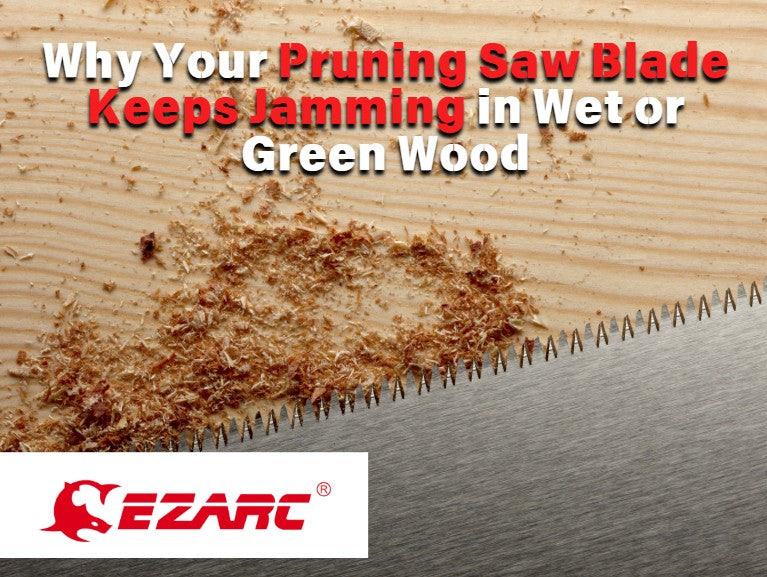
You're halfway through a branch, everything's going fine, and then it happens. The saw bogs down, the motor starts straining, and no matter how hard you push, the blade just won't move forward anymore. If this sounds familiar, you're not doing anything wrong. You're just fighting one of the most common problems in pruning: a blade that can't keep up with wet or green wood.
It's frustrating because it feels random. Sometimes the cut goes smooth, other times the same branch fights you the whole way. The truth is, it's rarely random at all. Wet and green wood behave very differently from dry lumber, and most reciprocating saw blades simply aren't built to handle that difference. Once you understand what's actually happening inside the cut, the fix becomes pretty obvious, and it usually just means switching to reciprocating saw blades made for the job.
What's Actually Causing the Jam
When people say a blade is "jamming," they're usually describing one of three related problems: binding, clogging, or overheating. In wet or green wood, all three tend to show up together.
Sap and moisture gum up the teeth. Green wood is full of moisture and, depending on the species, sap or resin. As the blade cuts, that moisture and sap mix with sawdust to form a sticky paste that packs into the gullets (the gaps between the teeth). Once those gullets fill up, the blade has nowhere to push the debris, so it just grinds against a wall of wet mush instead of cutting fresh wood.
Fine or shallow teeth can't clear debris fast enough. A lot of general purpose reciprocating saw blades are designed with tighter tooth spacing meant for metal or dry lumber. That works fine when the material is dry and brittle, but wet wood needs somewhere for all that extra moisture and pulp to go. Without deep gullets, the blade clogs almost immediately.
Straight blades don't follow the branch. A flat, straight blade cutting through a round branch has to fight the curve of the wood the entire way through. That extra friction generates heat, and heat is one of the fastest ways to dull a blade and make binding worse.
Heat buildup softens the teeth and warps the blade. Once friction starts building, the temperature at the cutting edge climbs fast. This is what causes that faint burning smell you sometimes get mid cut. Heat softens the metal, dulls the teeth, and in bad cases can actually warp the blade slightly, which makes binding even worse on the next stroke.
Put it all together and you get a vicious cycle. Moisture packs the gullets, packed gullets create friction, friction creates heat, and heat makes everything worse. This is exactly why so many Sawzall blades struggle in wet conditions even though they cut dry lumber just fine. The blade isn't broken. It's just outmatched by the material.
Why Standard Reciprocating Saw Blades Struggle So Much
Most Sawzall blades on the market are designed as generalists. They're built to handle a wide range of materials reasonably well, which means they don't specialize in anything. For demolition work, metal cutting, or dry framing lumber, that's totally fine.
Wet and green wood is a different animal. It needs reciprocating saw blades specifically engineered to move debris out of the cut fast, resist heat buildup, and follow the natural shape of a branch instead of fighting it. Without those features, you're basically asking a butter knife to do a chef's knife's job.

The Fix: Choosing the Right Reciprocating Saw Blade
The good news is this is almost always a blade problem, not a technique problem. Once you know which reciprocating saw blades to reach for, the fix is simple.
Start With Reciprocating Saw Blades Built for Wood, Not Metal
If you're currently using a general purpose blade, the first upgrade is switching to Sawzall blades specifically designed for pruning. EZARC's Japanese Teeth Arc Edge 15" Pruning Blade (6 TPI) is a solid starting point. It's built with aggressive Japanese style teeth and a curved arc edge profile that hugs the branch as it cuts instead of fighting the curve. The 6 TPI tooth count is coarse enough to bite into thick or green wood without instantly clogging, and the deep gullets give sawdust somewhere to go. It's a big step up from a generic demolition blade for anything involving live wood.
Go Further With a Blade Built Specifically for Wet Wood
If jamming keeps happening even with a decent pruning blade, the real culprit is usually moisture and sap outpacing the blade's chip clearance. That's exactly the problem EZARC's ProCut U-Groove Curved Pruning Blade was built to solve. It uses the same 6 TPI Japanese tooth geometry as the original pruning blade, but adds a U-Groove chip ejection channel that actively clears sawdust and sticky residue as you cut. Less material packed into the gullets means less friction, less heat, and a blade that keeps moving instead of grinding to a halt halfway through a wet limb.
Combine that with the anti-bind curved design and impulse hardened teeth (HRC 55 to 60), and you get a blade that's purpose built for exactly the conditions that cause jamming in the first place: spring pruning, storm cleanup, and resinous wood like pine.
Technique Tips to Prevent Jamming
A better blade solves most of the problem, but a few habits will help your reciprocating saw blades perform even better.
Use long, full strokes instead of short choppy ones. Longer strokes give sawdust and debris more room to clear out of the cut before the blade comes back around. Short, rapid strokes tend to pack material into the gullets faster than it can escape.
Ease off the pressure. It feels counterintuitive, but pushing harder when Sawzall blades start to bind almost always makes it worse. Extra pressure increases friction and heat, which is the opposite of what you want. Let the blade's teeth do the cutting and guide the saw rather than forcing it.
Support the branch properly. An unsupported branch can pinch the blade as it starts to sag under its own weight, especially near the end of a cut. This creates a mechanical bind that has nothing to do with the blade itself, so proper support matters just as much as blade choice.
Keep a spare blade on hand. Even the best reciprocating saw blades will eventually dull, especially on resinous or particularly wet wood. Both EZARC pruning blades come in multi packs specifically so a dulled blade never has to stall a job.
When Jamming Isn't About the Reciprocating Saw Blade at All
Occasionally the issue isn't the blade but the saw itself. A worn out shoe, loose blade clamp, or a stroke speed that's too slow for the material can all contribute to binding. If you've switched to a proper pruning blade and are still fighting jams regularly, it's worth checking those mechanical basics too. For a broader look at matching blades to different materials and troubleshooting common issues, check out our guide on how to select the right sawzall blade.
Final Thoughts
Jamming in wet or green wood almost always comes down to one thing: reciprocating saw blades that can't clear debris and manage heat fast enough for the material. Standard blades weren't designed with sap, moisture, and living wood fibers in mind, which is why they struggle. Swap in a blade actually built for the job, whether that's the Japanese Teeth Arc Edge for general pruning or the ProCut U-Groove for consistently wet conditions, and that frustrating grind to a halt mid cut becomes a thing of the past.
Ready to stop fighting your blade? Browse EZARC's full lineup of reciprocating saw blades and find the right one for whatever you're cutting next.
FAQ
Why does my saw blade smell like it's burning when cutting wet wood? That smell is a sign of heat buildup from friction, usually caused by sawdust and moisture packing into the gullets faster than the blade can clear it. Switching to a blade with deeper gullets and a chip ejection design, like the ProCut U-Groove, usually solves it.
Is a higher TPI better for cutting wet wood? No, the opposite is true. Higher TPI reciprocating saw blades have less space between teeth, which means less room to clear wet sawdust. A lower TPI, like 6 TPI, works better for green or wet branches.
Can I sharpen a jammed or dulled pruning blade? Reciprocating saw blades generally aren't practical to sharpen at home. Because they're inexpensive and sold in multi packs, replacing a dulled blade is usually faster and more reliable than trying to restore one.
Does branch diameter affect jamming? Yes. Thicker branches hold more moisture and require the blade to stay in the cut longer, which gives heat and debris more time to build up. Using a properly designed pruning blade matters even more as branch diameter increases.


Hinterlasse einen Kommentar
Diese Website ist durch hCaptcha geschützt und es gelten die allgemeinen Geschäftsbedingungen und Datenschutzbestimmungen von hCaptcha.